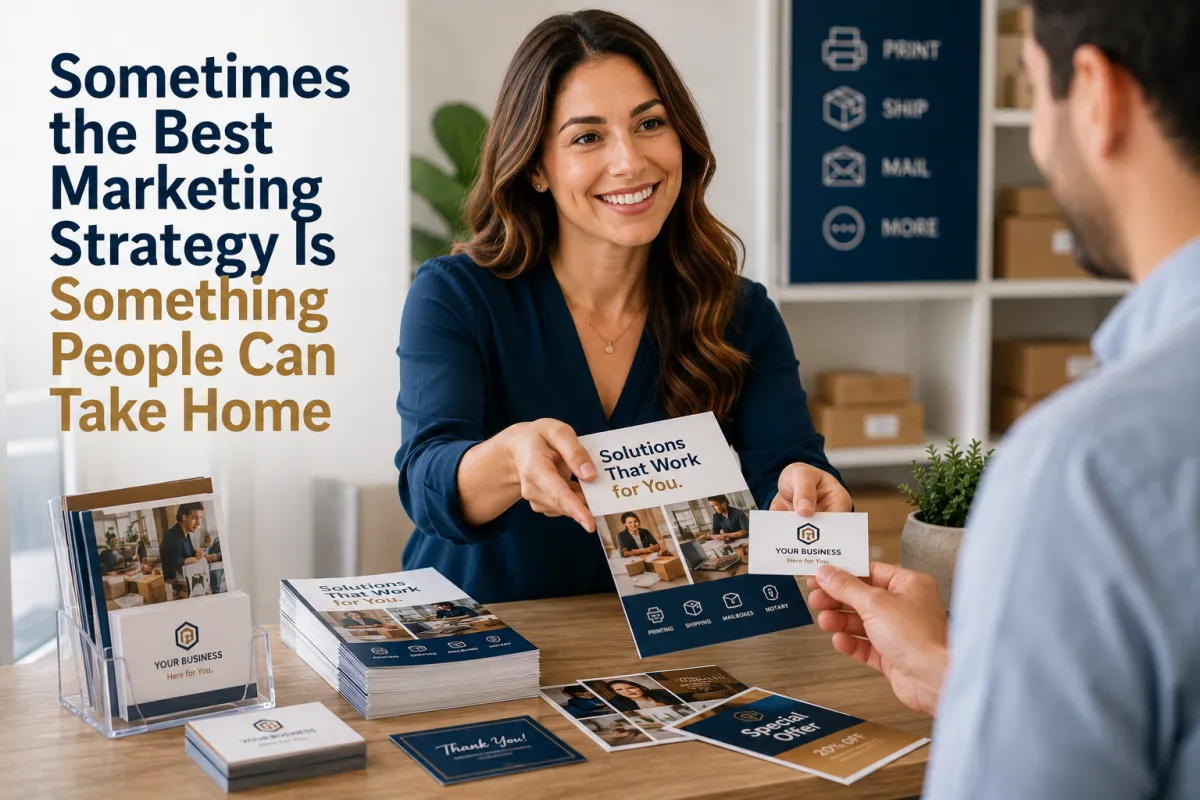
Sometimes the Best Marketing Strategy Is Something People Can Take Home
Sometimes the Best Marketing Strategy Is Something People Can Take Home
Digital marketing is everywhere.
Businesses compete for attention through social media posts, emails, online ads, videos, websites, and search results.
But there's one marketing channel that doesn't disappear when someone closes an app:
Something they can take home.
A business card tucked into a wallet.
A flyer sitting on a kitchen counter.
A postcard placed on a refrigerator.
A brochure left on a desk.
An event invitation sitting on a coffee table.
These physical materials may seem simple, but they can create something digital marketing sometimes struggles to provide:
A physical reminder of your business.
Why Does Physical Marketing Still Matter?
Digital marketing is valuable because it can reach people quickly and at scale.
But physical marketing has a different advantage.
It exists in the customer's physical environment.
A social media post can disappear from someone's feed within minutes.
A printed piece can remain visible for days, weeks, or even months.
That doesn't mean printed marketing is automatically more effective.
It means physical and digital marketing create different customer experiences.
The smartest businesses can use both.
1. People Can't Click What They Don't Remember
Imagine someone sees your social media advertisement.
They like it.
Then they scroll.
A few minutes later, they've seen another dozen posts.
By tomorrow, they may not remember your business at all.
Now imagine that same person receives a well-designed business card with your:
Business name
Logo
Phone number
Website
Service
QR code
They put it in their wallet.
Now your business has a physical presence beyond that initial interaction.
2. Take-Home Materials Extend the Marketing Conversation
A good marketing piece doesn't have to sell something immediately.
It can simply make it easier for someone to remember you later.
For example:
Someone needs a service today:
They contact you.
Someone doesn't need the service today:
They keep your information.
Three months later:
They suddenly need that service.
The printed material becomes a reminder.
This is particularly useful for businesses where customers don't necessarily need the service every day.
3. Business Cards Can Become Mini Marketing Tools
A business card doesn't have to be boring.
A modern business card can communicate:
Who you are + What you do + How to reach you
You can also include a QR code that connects customers to:
Your website
Booking page
Online portfolio
Social media
Contact form
Digital business card
That creates a simple bridge:
Physical card → Digital connection
The customer takes the card home, but the relationship can continue online.
4. Flyers Can Reach People Where They Live
Digital advertising reaches people through screens.
Flyers can reach them through physical spaces.
Depending on your audience and local rules, printed materials can be distributed or displayed in appropriate places such as:
Community boards
Local businesses
Events
Waiting areas
Neighborhood gatherings
Customer locations
A well-designed flyer should communicate the most important information quickly.
Think:
What is the offer?
Who is it for?
Why should they care?
What should they do next?
5. Postcards Can Stay Visible
A postcard doesn't require someone to open an email.
It can sit on a counter or refrigerator.
This makes postcards particularly interesting for local businesses promoting:
Seasonal offers
New services
Events
Grand openings
Community announcements
Appointment reminders
Special promotions
The physical format gives the message a chance to remain visible.
6. Brochures Can Explain More
Some businesses have services that are difficult to explain in one sentence.
A brochure gives you more space.
It can help explain:
Services
Pricing structures
Processes
Benefits
Frequently asked questions
Contact information
Instead of trying to explain everything during one conversation, you can give the customer something they can review later.
7. Printed Materials Can Build Brand Recognition
Marketing isn't only about getting someone to buy.
It's also about becoming recognizable.
When your:
Business cards
Flyers
Brochures
Signage
Packaging
Website
Social media
use consistent branding, customers begin to associate those visual elements with your business.
That can include consistent:
Logo
Typography
Colors
Photography
Messaging
Your printed materials become another part of your overall brand identity.
8. The Design Matters
A printed marketing piece has only a few seconds to make an impression.
That doesn't mean it needs to be complicated.
In fact, simple is often more effective.
Focus on:
Clear Headline
Tell people what you're offering.
Strong Visual
Use imagery that supports the message.
Easy-to-Read Information
Avoid filling every available space.
Clear Call to Action
Tell people what to do next.
For example:
Scan to Book
Call Today
Visit Our Website
Learn More
A good marketing piece should make the next step obvious.
9. Don't Try to Put Everything on One Piece
One common mistake businesses make is trying to explain their entire company on a single flyer.
More information doesn't necessarily mean more effective marketing.
Instead, prioritize.
Ask:
What's the ONE thing I want someone to remember?
Then build the design around that message.
A business card might focus on your service.
A flyer might promote one offer.
A brochure might explain several services.
Different materials can have different jobs.
10. Add a Digital Element
Printed marketing doesn't have to be disconnected from your online presence.
A QR code can help customers move from the physical world to the digital one.
For example:
Flyer → QR code → Website → Appointment
Or:
Business card → QR code → Portfolio
Or:
Postcard → QR code → Promotion
This gives physical marketing a measurable next step.
Just make sure the QR code:
Is large enough to scan
Has sufficient contrast
Leads to a mobile-friendly page
Goes directly to something relevant
Is tested before printing
11. Physical Marketing Can Be Especially Useful for Local Businesses
Local businesses have an advantage that purely online businesses don't always have:
They can connect with customers in the real world.
A local customer might discover your business through:
A referral
A business card
A flyer
An event
A community partnership
A printed coupon
A brochure
The physical material gives the customer something to remember after the interaction ends.
12. Take-Home Marketing Can Encourage Referrals
Imagine a customer loves your service.
They tell a friend:
"You should try this business."
If they have your business card or brochure nearby, they can hand it over.
Now your marketing material isn't just reaching one person.
It can become a referral tool.
That's one of the most useful things about physical marketing:
It's easy to pass along.
13. Printed Materials Can Make Events More Effective
Events create opportunities for face-to-face connections.
But conversations end.
People go home.
And that's where printed materials can help.
Give attendees something they can take with them:
Business card
Flyer
Brochure
Event card
Coupon
Service guide
Branded information sheet
The event creates the relationship.
The printed material helps preserve the connection.
14. Quality Matters More Than Quantity
Printing 5,000 poorly designed flyers isn't necessarily better than printing 500 well-designed ones.
Before ordering a large quantity, consider:
Is the information correct?
Is the design easy to understand?
Is the branding consistent?
Is the call to action clear?
Is the print quality appropriate?
Is the material suitable for the audience?
A smaller quantity of effective materials can be more useful than a large quantity of materials nobody wants to keep.
15. Think About What People Would Actually Keep
Here's an important marketing question:
Would someone throw this away immediately—or actually keep it?
A useful piece of marketing has a reason to stay.
For example:
Business card: Contact information
Service guide: Useful reference
Calendar: Practical reminder
Coupon: Future savings
Event card: Important date
Brochure: Helpful information
The more useful the item is, the more likely someone may keep it.
16. Marketing Shouldn't Always Feel Like Advertising
People are exposed to advertising constantly.
That's why useful marketing can feel different.
Instead of:
"BUY NOW!"
Think:
"Here's something useful."
Educational content can be printed too.
For example:
Packing checklists
Business tips
Document checklists
Event guides
How-to information
Maintenance reminders
If your business helps solve a problem, your marketing can demonstrate that expertise.
A Simple Take-Home Marketing Strategy
You don't need dozens of printed materials.
Start with three.
1. Business Card
For networking and referrals.
2. One Strong Flyer
For a specific service, promotion, or campaign.
3. Informative Brochure or Service Guide
For customers who need more information.
Then connect all three to your digital presence.
Print → Scan → Visit → Connect
That creates a simple integrated marketing system.
When Should You Use Print Marketing?
Print marketing can be especially useful when:
Your business serves a local community
You attend networking events
Customers refer friends
You have a physical location
You offer multiple services
You participate in community events
You want customers to remember an offer
Your information benefits from physical reference
It's not right for every campaign.
But it shouldn't automatically be dismissed just because digital marketing is popular.
How Ship It - Bay & Beyond Can Help
At Ship It - Bay & Beyond, we help businesses turn ideas into professional printed materials that customers can actually take with them.
Business Card Printing
Create professional business cards for networking, referrals, and everyday business connections.
Flyers & Marketing Materials
Promote services, events, seasonal campaigns, and special offers with professionally printed materials.
Brochures
Give customers a physical resource that explains your services and provides important contact information.
Document Printing & Copying
Handle everyday business documents and printed materials conveniently.
Large-Format Printing
Create larger visual materials for events, promotions, displays, and other business needs.
Packing & Shipping
Send marketing materials, products, documents, and packages professionally.
Private Mailboxes
Dedicated mailing solutions for personal or business correspondence and eligible packages, subject to applicable requirements.
Package Receiving
Convenient receiving options for eligible business and personal packages.
Document Scanning
Digitize eligible documents for easier organization and access.
Secure Document Shredding
Securely dispose of confidential paper materials once you've confirmed they no longer need to be retained.
Notary Services
Notary services for eligible personal and business documents.
Fingerprinting
Fingerprinting services for eligible employment, licensing, and other requirements.
Passport Photos
Professional passport photo services for eligible applications.
Proudly Serving the Tampa Bay Area
Ship It - Bay & Beyond proudly serves individuals, families, entrepreneurs, and businesses throughout the Tampa Bay region, including:
St. Petersburg
Tampa
Clearwater
Largo
Pinellas Park
Seminole
Gulfport
Kenneth City
Treasure Island
St. Pete Beach
Madeira Beach
Indian Rocks Beach
Indian Shores
Redington Beach
North Redington Beach
Redington Shores
Safety Harbor
Oldsmar
Dunedin
Palm Harbor
Tarpon Springs
Belleair
Belleair Bluffs
Lealman
Pinellas County
Hillsborough County
Surrounding communities
Whether you need professional packing and shipping, printing, private mailbox services, virtual mailbox services, package receiving, notary services, fingerprinting, secure shredding, document scanning, copying, passport photos, business formation, or office services, Ship It! Bay & Beyond is your trusted local partner.
The Bottom Line
Digital marketing isn't going away.
And it shouldn't.
But that doesn't mean physical marketing has stopped working.
Sometimes the best marketing strategy is something simple:
Something useful.
Something memorable.
Something someone can put in their wallet, place on their desk, stick on the refrigerator, or hand to a friend.
A physical marketing piece gives your business a presence beyond the screen.
And when it's designed well, it doesn't have to compete with your digital marketing.
It can lead people to it.
So the next time you're planning a marketing campaign, don't ask only:
"What can we post?"
Also ask:
"What can we give people to take home?"
That might be the piece of marketing they remember.
Frequently Asked Questions
Is print marketing still effective in 2026?
Print marketing can still be useful, particularly for local businesses, networking, referrals, events, and campaigns where customers benefit from having physical information available. Its effectiveness depends on the audience, message, design, distribution, and overall marketing strategy.
What are examples of tangible marketing materials?
Common examples include business cards, flyers, brochures, postcards, posters, invitations, calendars, coupons, menus, and branded informational materials.
Should printed marketing include a QR code?
A QR code can be useful when it connects customers to a relevant digital destination such as a website, booking page, promotion, portfolio, or contact form. Always test the QR code before printing.
How much information should I put on a flyer?
Focus on the most important message. Include a clear headline, essential details, relevant visual content, and a simple call to action rather than trying to explain everything about your business.
Is professional printing worth it for small businesses?
Professional printing can be valuable when you need consistent quality, specific paper options, larger formats, or polished business and marketing materials that represent your brand.
Can print marketing and digital marketing work together?
Absolutely. A printed piece can direct customers to a website, social media profile, booking page, or other digital destination through a QR code or simple web address. This creates a connection between offline and online marketing.
