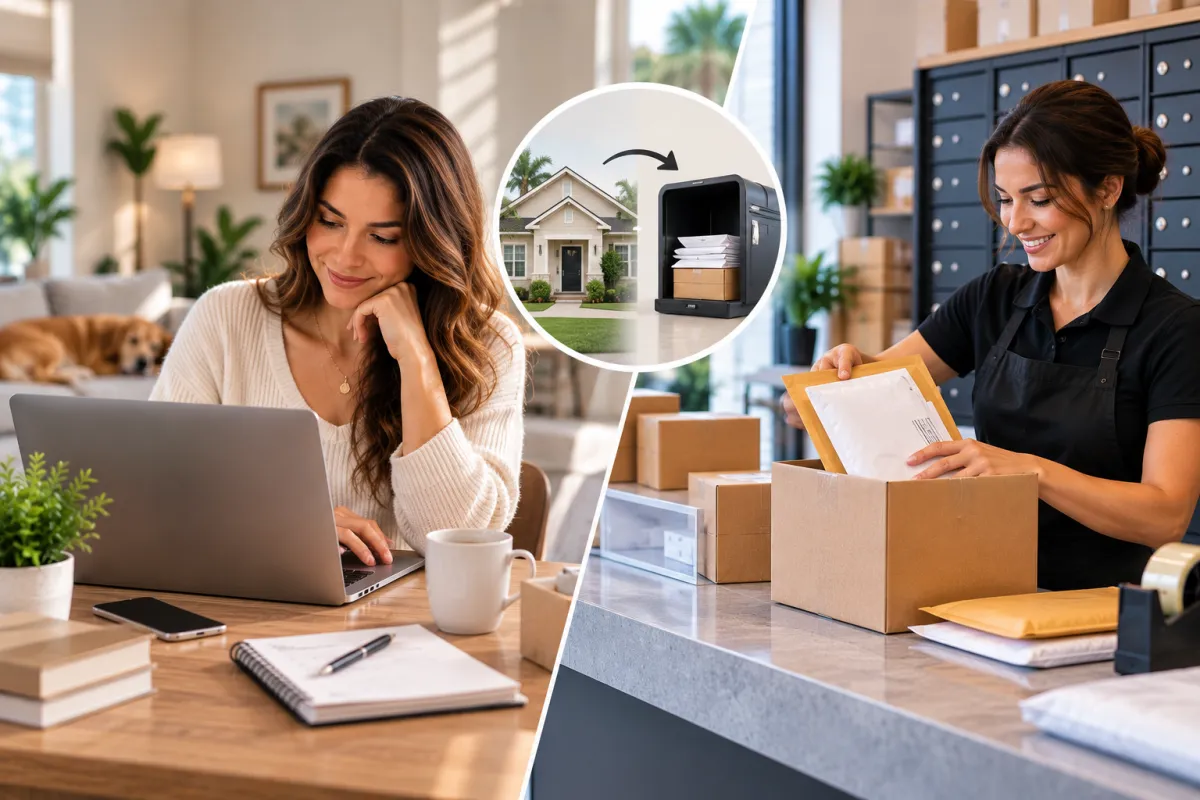
Your Business Can Be Digital Without Your Mailing Address Being Personal
Your Business Can Be Digital Without Your Mailing Address Being Personal
Your website is digital.
Your payments are digital.
Your customer communication happens online.
Your marketing lives on social media.
Your files are stored in the cloud.
So why does your home address have to become part of your business?
For many entrepreneurs, especially those working from home, starting an online business doesn't require renting a traditional office.
But that can create an uncomfortable question:
Where should your business mail go?
Using your home address may seem like the easiest solution.
Until you start receiving business correspondence, packages, returns, invoices, and other mail connected to your business.
Suddenly, your personal address is doing double duty.
And that's where separating your business mailing address from your home address can become worth considering.
Your Business Doesn't Have to Have a Traditional Office
One of the biggest changes in modern entrepreneurship is that businesses can operate from almost anywhere.
You might work from:
A home office
A coworking space
A shared workspace
A studio
A coffee shop
A mobile office
Multiple locations
Your business can be completely legitimate without having a traditional storefront.
But being location-flexible doesn't mean your business doesn't need a reliable mailing solution.
Businesses still receive:
Correspondence
Documents
Packages
Invoices
Marketing materials
Customer communications
Vendor information
Digital operations don't eliminate physical mail.
They simply change how you manage it.
Why Use Your Home Address for Business?
For many new entrepreneurs, it's understandable.
You're starting small.
You don't want to spend money on an office.
You need an address.
Your home already has one.
Problem solved.
Except your home address isn't just a business detail.
It's also where you live.
Depending on how your business operates, your address may appear on:
Business correspondence
Customer communications
Invoices
Online listings
Public-facing materials
Shipping information
Business registrations or filings where required
The exact address requirements vary by business type, location, agency, and purpose.
That's why it's important to understand where an address is actually required before choosing one.
1. Privacy Is a Practical Business Consideration
Your home is your personal space.
Your business is your professional operation.
Keeping those two roles separate can provide an additional layer of privacy.
For home-based entrepreneurs, this can be particularly useful when the business involves frequent customer or vendor interactions.
A business mailing address can help prevent your residential address from becoming the default destination for routine business correspondence.
Professional doesn't have to mean public access to your home.
2. A Mailing Address Is Not Necessarily a Physical Business Location
This distinction is important.
A mailing address is where correspondence is received.
A physical business location is where business operations actually take place.
They may be the same.
They may also be different.
For example, an entrepreneur might:
Work from home → Use a separate business mailing solution → Meet clients elsewhere
That doesn't automatically mean the mailing address is the company's physical operating location.
Businesses should accurately represent their addresses and follow the requirements of the agencies, banks, platforms, licensing bodies, and other organizations they're dealing with.
3. A Private Mailbox Can Create a Professional Mailing Solution
A private mailbox can provide a dedicated mailing address for eligible personal or business correspondence and packages.
For a small business, that can help create separation between:
Home life
and
Business mail.
Depending on the provider and service, a private mailbox may offer features such as:
Dedicated mailbox space
Mail receiving
Package receiving
Convenient access
A consistent mailing address
The exact features and address-acceptance rules vary, so businesses should confirm whether a particular mailbox meets the requirements of the organization where the address will be used.
4. It Can Be Useful for Home-Based Businesses
A home-based business may not need a commercial office.
But it may still receive business mail regularly.
Consider an entrepreneur who sells products online.
They might receive:
Supplier correspondence
Product samples
Returns
Business documents
Packages
Promotional materials
Sending everything to the home can quickly blur the line between personal and business life.
A dedicated mailing solution can help establish a clearer system.
5. Remote Businesses Still Need Physical Infrastructure
Remote work can make a business feel almost entirely digital.
But eventually something physical shows up.
A contract needs to be printed.
A package arrives.
A return needs to be received.
A document needs to be scanned.
A customer needs something shipped.
Mail accumulates.
Remote doesn't mean physical needs disappear.
It means businesses need systems for handling those physical needs efficiently.
6. A Consistent Address Can Help When You're Always Moving
Some entrepreneurs aren't in the same place every day.
They may:
Travel frequently
Work remotely
Operate seasonally
Work from multiple locations
Relocate periodically
Constantly changing a business mailing address can create unnecessary administrative work.
A consistent mailing solution may make it easier to maintain continuity for eligible correspondence.
Instead of your business mail following your physical location, your mailing system can remain consistent while your work location changes.
7. Package Receiving Is Another Consideration
Businesses don't just receive envelopes.
They receive boxes.
Depending on the business, this could include:
Inventory
Supplies
Samples
Equipment
Customer returns
Promotional materials
If you're not always available at home, package receiving can become a practical concern.
A mailbox or package receiving service may provide a more predictable destination for eligible deliveries.
8. A Business Address Can Help Separate Personal and Professional Mail
Imagine opening your mailbox and finding:
Personal bills
Business invoices
Customer correspondence
Packages
Government notices
Marketing mail
all mixed together.
It can become difficult to manage.
Separating business correspondence from personal mail can make organization easier.
You can create a simple system:
Personal
Home-related mail and personal correspondence.
Business
Business correspondence and eligible packages.
Digital
Scanned documents and electronic records.
Secure Disposal
Confidential paperwork that you've confirmed no longer needs to be retained.
9. A Professional Mailing Address Doesn't Replace Every Other Address
This is one of the most important points.
A business mailing address isn't necessarily appropriate for every purpose.
Certain situations may require:
A physical location
A residential address
A registered-agent address
A specific government-approved address
A location where business activities actually occur
Requirements can vary by jurisdiction and organization.
Don't use a mailing address simply because it looks professional.
Use the address that is appropriate for the specific purpose.
When you're unsure, verify the requirements with the relevant agency, bank, licensing authority, attorney, or other qualified professional.
10. Banks and Online Platforms May Have Their Own Requirements
Opening a business bank account or setting up an online business profile may involve address verification.
Some institutions distinguish between:
Business mailing address
Physical business address
Residential address
Don't assume that one address can automatically serve all three purposes.
Provide accurate information based on what the application specifically requests.
The goal isn't to hide your address.
It's to use the right address for the right purpose.
11. Your Website Doesn't Need to Display Your Home Address
A website may need business contact information depending on your industry, location, and applicable requirements.
But there is a difference between providing customers with a way to contact your business and unnecessarily publishing your residential address.
Consider whether your website actually needs to display your home address.
Depending on your business model, you may be able to provide:
Business mailing address
Phone number
Email address
Contact form
Appointment information
Service area
Always follow any applicable disclosure requirements for your industry and location.
12. A Business Mailing Address Can Support a More Professional Image
First impressions aren't everything.
But they matter.
A consistent business mailing address can make your business operations feel more organized.
It can appear on appropriate:
Business correspondence
Marketing materials
Invoices
Business cards
Shipping materials
That can help create consistency across your business communications.
But remember:
Professionalism comes from the entire customer experience—not simply the address.
13. It Can Help Create Boundaries
There's another benefit that's easy to overlook:
Mental separation.
When business mail arrives at your home, it can make it harder to switch off from work.
A separate mailing location can create a clearer boundary.
Instead of:
"The business is always here."
you can create:
"This is my home. This is where my business mail is managed."
For entrepreneurs who work from home, that distinction can be valuable.
14. Your Mailing Address Can Become Part of Your Workflow
Think of your business address as one part of your operating system.
For example:
Customer places order
↓
Business receives correspondence
↓
Packages arrive
↓
Documents are scanned or organized
↓
Important records are retained
↓
Unnecessary confidential documents are securely shredded
↓
Outgoing packages are packed and shipped
That's more than an address.
It's a mail-management system.
15. Virtual Mailboxes Add Another Layer of Flexibility
For entrepreneurs who aren't always physically available, a virtual mailbox may offer additional convenience.
Depending on the service, features can include:
Mail notifications
Digital mail previews
Mail forwarding
Remote mail management
Mail organization
This can be useful for:
Frequent travelers
Remote entrepreneurs
Digital businesses
Seasonal residents
Professionals working across locations
Again, service features and address-acceptance rules vary.
16. Don't Forget About Business Mail Security
Mail can contain sensitive information.
Business correspondence may include:
Customer information
Financial records
Contracts
Account information
Tax documents
Business plans
Personal information
That means your mailing strategy should consider security as well as convenience.
Think about:
Who can access the mail
Where packages are delivered
How mail is stored
How documents are scanned
How confidential paperwork is disposed of
A good mailing system should protect information throughout its lifecycle.
17. Old Business Mail Can Become a Security Risk
Your business may eventually accumulate years of paperwork.
Don't simply keep everything forever.
Review documents according to your business's retention requirements.
When confidential records no longer need to be retained, secure destruction can help reduce unnecessary exposure.
This might include:
Old invoices
Outdated customer records
Financial statements
Shipping documents
Printed business information
Good mail management includes knowing when to let paperwork go.
18. Digitizing Mail Can Make Remote Business Easier
For eligible documents, scanning can turn physical paperwork into digital files.
A simple workflow might be:
Receive → Review → Scan → Organize → Back Up → Retain or Securely Dispose
This can make important information easier to access when you're working remotely.
But scanning doesn't automatically mean the original can be destroyed.
For important legal, tax, identification, financial, or other records, determine whether the original must be retained.
19. Think Beyond the Address
The biggest mistake is thinking:
"I just need an address."
You actually need a system.
Ask:
Where will business mail arrive?
Who can access it?
How will packages be handled?
What happens when you're traveling?
How will documents be scanned?
How will confidential paperwork be destroyed?
How will outgoing shipments be handled?
That's where a full-service business support location can become especially useful.
20. Your Business Can Be Digital and Still Need a Physical Partner
You can run:
Marketing online
Sales online
Customer service online
Accounting digitally
Meetings virtually
and still need somewhere to:
Receive packages
Print documents
Scan paperwork
Ship products
Handle mail
Notarize documents
Manage physical business tasks
Digital business doesn't mean digital-only business.
A Simple Business Address Checklist
Before using your home address for business, ask:
Privacy
☐ Am I comfortable using my residential address publicly or for routine business correspondence?
☐ How much business mail do I expect?
Packages
☐ Where will business packages be delivered?
Travel
☐ What happens when I'm away?
Organization
☐ How will I separate business and personal mail?
Compliance
☐ Does the organization I'm dealing with require a specific type of address?
Security
☐ How will confidential documents be stored and destroyed?
Digital Access
☐ Can eligible paperwork be scanned and backed up?
These questions can help you determine whether your current mailing setup still makes sense.
How Ship It - Bay & Beyond Can Help
At Ship It - Bay & Beyond, we help entrepreneurs, home-based businesses, remote professionals, and established companies manage the physical side of business operations.
Private Mailboxes
Dedicated mailing solutions for personal or business correspondence and eligible packages, subject to applicable requirements.
Virtual Mailboxes
Flexible mail-management options for people who aren't always in one location, depending on available service features.
Package Receiving
Convenient receiving options for eligible packages.
Packing & Shipping
Professional packing and shipping assistance for business products, documents, supplies, and customer orders.
Printing & Copying
Print business cards, flyers, forms, contracts, marketing materials, and everyday business documents.
Document Scanning
Digitize eligible paperwork for easier organization, access, and backup.
Secure Document Shredding
Securely dispose of confidential business paperwork after confirming it no longer needs to be retained.
Notary Services
Notary services for eligible business and personal documents.
Fingerprinting
Fingerprinting services for eligible employment, licensing, and other requirements.
Passport Photos
Professional passport photo services for eligible applications.
Business Formation Assistance
Support for entrepreneurs handling practical business setup and administrative needs.
Proudly Serving the Tampa Bay Area
Ship It! Bay & Beyond proudly serves individuals, families, entrepreneurs, remote professionals, and businesses throughout the Tampa Bay region, including:
St. Petersburg
Tampa
Clearwater
Largo
Pinellas Park
Seminole
Gulfport
Kenneth City
Treasure Island
St. Pete Beach
Madeira Beach
Indian Rocks Beach
Indian Shores
Redington Beach
North Redington Beach
Redington Shores
Safety Harbor
Oldsmar
Dunedin
Palm Harbor
Tarpon Springs
Belleair
Belleair Bluffs
Lealman
Pinellas County
Hillsborough County
Surrounding communities
Whether you need professional packing and shipping, printing, private mailbox services, virtual mailbox services, package receiving, notary services, fingerprinting, secure shredding, document scanning, copying, passport photos, business formation, or office services, Ship It! Bay & Beyond is your trusted local partner.
The Bottom Line
You don't need a traditional office to run a modern business.
But you may still need a reliable way to handle the physical side of business ownership.
Your business can be:
Digital.
Remote.
Flexible.
Home-based.
And still have a mailing system that doesn't require making your home address the center of your business operations.
Before putting your residential address on everything, think about:
Privacy.
Mail volume.
Package receiving.
Travel.
Organization.
Security.
Address requirements.
A private or virtual mailbox may be worth considering for some businesses—but it should be used appropriately and doesn't automatically replace every type of required address.
Your business can be everywhere online without making your home address part of the public-facing experience.
That's not about hiding your business.
It's about building better boundaries and better systems.
Frequently Asked Questions
Can I use my home address for my business?
In many situations, a home address may be used for business purposes, but the appropriate address depends on the business, jurisdiction, agency, and purpose. Before using your home address, consider privacy and verify any applicable requirements.
What is a business mailing address?
A business mailing address is an address used to receive business correspondence and, depending on the service, eligible packages. It doesn't necessarily mean the business physically operates at that location.
What is a private mailbox?
A private mailbox is a dedicated mailbox service that can receive eligible mail and packages. It can provide a consistent mailing address for personal or business use, subject to applicable requirements and provider policies.
Can a private mailbox replace my business's physical address?
Not necessarily. Some organizations require a physical operating address, registered-agent address, residential address, or another specific address. Always verify the requirements for the intended use.
What is a virtual mailbox?
A virtual mailbox is a mail-management service that may provide features such as digital mail previews, notifications, forwarding, and remote management. Features and address-use rules vary by provider.
Why would a home-based business want a separate mailing address?
Potential reasons include privacy, separating personal and business mail, package receiving, maintaining a consistent mailing location, and creating clearer boundaries between home and business operations.
Does a business mailing address make my business look more professional?
A consistent business mailing address can contribute to an organized professional presentation, but professionalism depends on the overall business experience, including communication, service, branding, and reliability.
