The Fingerprinting Process Explained: A Simple Guide
The Fingerprinting Process Explained Without the Jargon
Introduction: Fingerprinting Doesn't Have to Be Complicated
Have you ever been told you need to get fingerprinted for a new job, professional license, volunteer position, or background check—and immediately wondered what that actually means?
You might hear terms like Live Scan, electronic submission, ORI number, or background screening. If you're unfamiliar with the process, these words can make a simple appointment sound more complicated than it really is.
Here's the good news: fingerprinting is generally straightforward when you know what to expect.
In simple terms, fingerprinting involves capturing the unique patterns on your fingertips so they can be used for identification or, when required, a fingerprint-based background check.
Let's walk through the process step by step, without the confusing terminology.
1. First, Understand Why You Need Fingerprinting
Before scheduling an appointment, find out who is requesting your fingerprints and why.
Fingerprinting may be required for certain:
Employment opportunities
Professional licenses and certifications
Healthcare or childcare positions
Government-related applications
Volunteer positions involving specific screening requirements
Background checks required by an authorized organization
Not every employer or license requires fingerprinting. The exact process depends on the organization requesting it.
Your first step: Read the instructions from your employer, licensing board, or requesting agency. These instructions should explain which type of fingerprinting you need and how your fingerprints must be submitted.
2. What Is Electronic Fingerprinting?
Electronic fingerprinting is a process that captures your fingerprints using a digital scanner rather than traditional ink and paper.
You place your fingers on a specialized scanning surface, and the equipment captures the patterns of your fingerprints.
You may hear this process called Live Scan fingerprinting. The term commonly refers to electronic fingerprint capture, although the exact services and submission procedures vary by provider and program.
Why do many programs use electronic fingerprinting?
It avoids the need for ink on your fingers.
The captured images can be checked for quality.
Fingerprints may be submitted electronically through an approved system.
It can reduce the need to mail physical fingerprint cards when electronic submission is accepted.
However, electronic fingerprinting isn't automatically accepted for every application. Always confirm the method required by the organization requesting your fingerprints.
3. What Happens During a Fingerprinting Appointment?
If you've never been fingerprinted before, knowing what happens can help you feel more prepared.
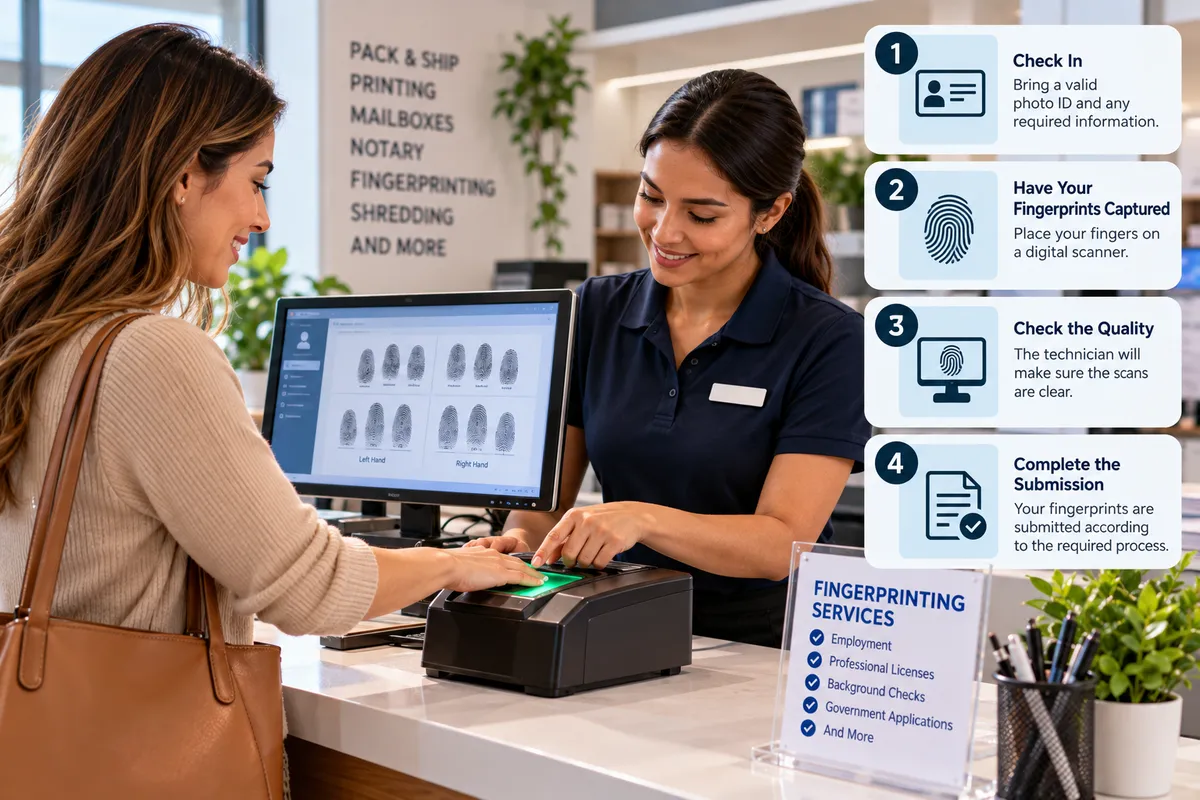
<text color="secondary" size="sm">Here's the process in four simple steps.</text>
Step 1: Check in and verify your information
The provider may ask for your identification, appointment confirmation, and information related to the agency or organization requesting the fingerprints.
Make sure your personal information is accurate. Incorrect details can cause delays or submission problems.
Step 2: Have your fingerprints captured
For electronic fingerprinting, you'll place your fingers on a digital scanner as instructed by the technician.
The scanner captures the ridges and patterns on your fingertips. The technician may guide you through positioning each finger correctly.
Step 3: Check the quality
Clear fingerprint images are important. If a scan is unclear, the technician may ask you to reposition your fingers or repeat part of the process.
Dry skin, excessive moisture, worn fingerprints, or certain skin conditions can sometimes make capturing clear prints more challenging. If you have difficulty getting a clear scan, let the technician know.
Step 4: Complete the submission process
Depending on the service, your fingerprints may be submitted electronically through an approved channel or provided in another format required by the requesting organization.
Before leaving, ask whether your submission is complete and whether you'll receive a receipt or confirmation number.
Remember: Completing the fingerprint appointment doesn't necessarily mean your background check is finished. The receiving agency may need additional time to process and review the information.
4. What Do Those Fingerprinting Terms Actually Mean?
Let's translate some common terms into everyday language.
Term | What it means |
|---|---|
Live Scan | A common term for electronic fingerprint capture. |
Fingerprint background check | A screening process that uses fingerprints to help identify records associated with an individual. |
ORI number | An identifier used in certain systems to direct fingerprints or related information to the correct agency. |
Electronic submission | Sending fingerprint information digitally through an approved system. |
Fingerprint card | A physical card on which fingerprints are recorded, often using ink. |
Processing time | The time the receiving agency needs to process a submission and complete its review. |
Rejected prints | Fingerprint submissions that cannot be accepted or processed, sometimes because of image quality or other technical issues. |
You don't need to memorize every term. The most important thing is to follow the instructions provided by the organization requesting your fingerprints.
5. What Should You Bring to Your Appointment?
A little preparation can make the process easier.
Before leaving home, confirm what your specific program requires. Your checklist may include:
Valid identification: Bring an accepted government-issued photo ID.
Appointment details: Have your booking confirmation ready, if applicable.
Agency instructions: Bring any required forms, codes, or authorization information.
Application details: Some programs require an ORI number or other information identifying the requesting agency.
Payment: Confirm the service fee and accepted payment methods in advance.
Requirements vary by program, so don't assume the same documents will work for every appointment.
If you're unsure what to bring, contact the fingerprinting provider before your visit.
6. How Long Does Fingerprinting Take?
There are two separate timelines: the appointment and the background-check process.
The actual fingerprint capture may take only a short appointment, depending on the provider, required paperwork, and whether the fingerprints need to be captured more than once.
The background check may take longer. Processing times depend on the receiving agency, the type of screening, the submission method, and whether additional review is necessary.
If you're completing fingerprinting for a job or professional license, ask your employer or licensing agency how far in advance you should schedule it.
A helpful tip: Complete fingerprinting as early as permitted rather than waiting until your deadline is approaching.
7. What Happens After Your Fingerprints Are Taken?
Once your fingerprints have been captured, the next steps depend on the program.
Your fingerprint information may be sent to an authorized recipient, which then follows the applicable background-check procedures. The requesting organization may review the results as part of its hiring, licensing, or application process.
You may need to wait for an update, check your application status, or provide additional information if requested.
Keep your receipt or confirmation details until you know your submission has been received and your application is progressing.
Also, remember that a fingerprinting provider generally cannot guarantee the outcome of a background check or the approval of a job or license. Those decisions belong to the responsible employer or agency.
8. Simple Ways to Avoid Fingerprinting Delays
You don't need special technical knowledge to prepare for fingerprinting. A few simple steps can help:
Follow the exact instructions. Confirm the correct type of fingerprinting and submission process.
Double-check your details. Make sure your name and other required information are accurate.
Bring the right identification. Verify accepted ID before your appointment.
Allow enough time. Remember that background-check processing happens after fingerprint capture.
Ask questions early. Clarify anything you don't understand before arriving.
Keep your confirmation. Save your receipt or reference number in case you need to follow up.
The goal is to arrive prepared, complete the required steps, and know what happens next.
How Ship It - Bay & Beyond Can Help
If you need fingerprinting for an employment application, professional license, or another qualifying requirement, Ship It - Bay & Beyond offers fingerprinting services alongside a variety of convenient business and document services in St. Petersburg, Florida.
We understand that the process can feel unfamiliar when you're doing it for the first time. Before visiting, contact our team to confirm service availability, accepted identification, appointment requirements, and whether we can accommodate the specific fingerprinting program requested by your employer or licensing agency.
You can also access other services at our location, including:
Packing and shipping
Private mailboxes and package receiving
Printing, copying, and scanning
Notary services
Passport photos
Document shredding
Business services
U-Haul rentals and moving supplies
Visit us at:
Ship It - Bay & Beyond
5420 Central Ave
St. Petersburg, FL 33707
Phone: 727-344-9052
Email:[email protected]
Business hours: Monday–Friday, 9 AM–6 PM; Saturday, 9 AM–3 PM; Sunday closed.
Call ahead so we can help you determine whether our available fingerprinting services match your requirements.
Proudly Serving the Tampa Bay Area
Ship It - Bay & Beyond proudly serves individuals, professionals, job applicants, and small businesses throughout:
St. Petersburg
Tampa
Clearwater
Largo
Pinellas Park
Seminole
Gulfport
Kenneth City
Treasure Island
St. Pete Beach
Madeira Beach
Indian Rocks Beach
Indian Shores
Redington Beach
North Redington Beach
Redington Shores
Safety Harbor
Oldsmar
Dunedin
Palm Harbor
Tarpon Springs
Belleair
Belleair Bluffs
Lealman
Pinellas County
Hillsborough County
Surrounding communities
Whether you need fingerprinting, notary services, printing, document scanning, secure shredding, passport photos, private mailbox services, package receiving, packing and shipping, or other office services, Ship It - Bay & Beyond is your local partner for everyday needs.
The Bottom Line
Fingerprinting may sound technical, but the basic process is simple: confirm what your organization requires, bring the correct information, have your fingerprints captured, and follow the instructions for submission and processing.
Understanding each step can help you feel more confident and avoid unnecessary delays.
Whether you're preparing for a new job, applying for a professional license, or completing another background-check requirement, a little preparation goes a long way.
Let's talk! Have you completed a fingerprinting appointment before, or will this be your first time? What questions do you have about the process? Share them in the comments!
