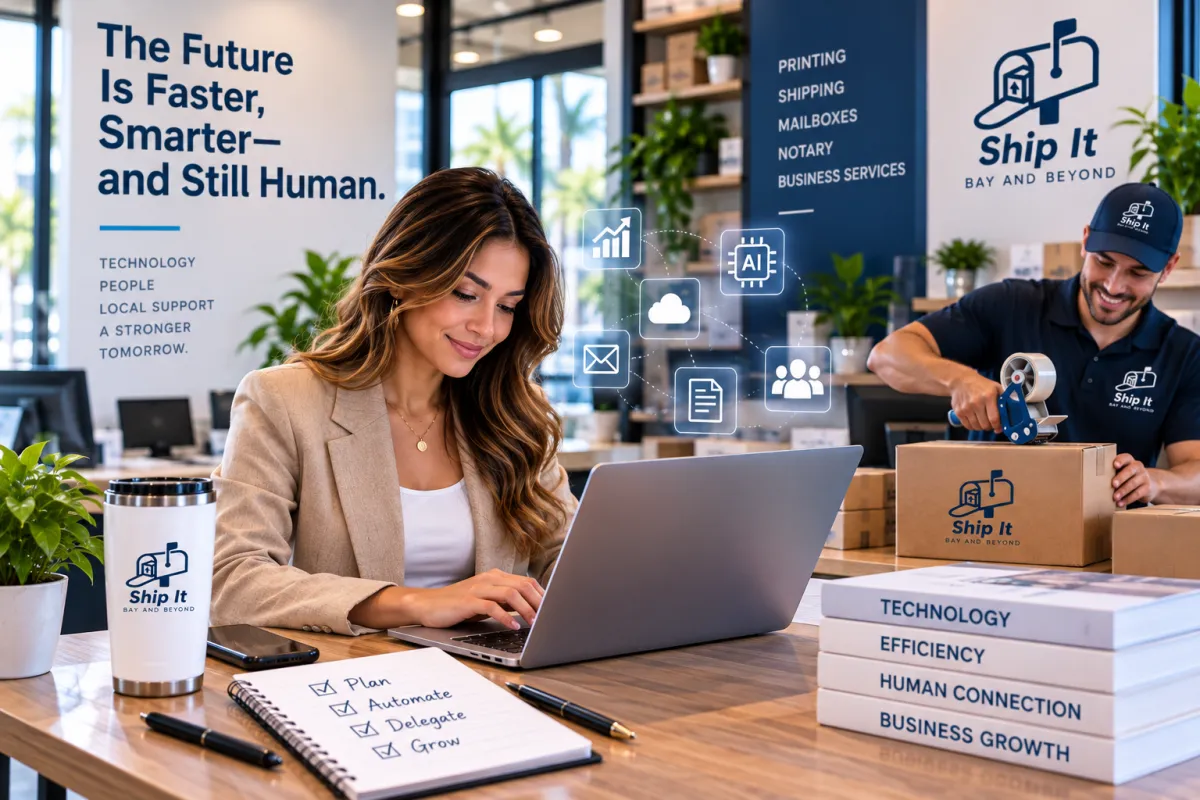
The Future Is Faster, Smarter—and Still Human: What It Means for Small Businesses
The Future Is Faster, Smarter—and Still Human
Business is changing quickly.
Artificial intelligence can generate content in seconds. Automation can handle repetitive tasks. Digital platforms can connect businesses with customers almost instantly. Cloud tools allow teams to work from nearly anywhere.
The future of business is becoming faster and smarter.
But there's another part of the future that technology can't replace:
People.
Customers still want clear answers. Business owners still need reliable partners. Employees still need communication and support. And some tasks still require human judgment, physical handling, and personal attention.
The future isn't necessarily about choosing between technology and people.
It's about figuring out where technology helps and where human connection matters most.
Business Is Getting Faster
Technology has changed the speed of everyday business.
A task that once took hours can sometimes be completed in minutes.
Businesses can now:
Send documents instantly
Communicate with customers in real time
Automate repetitive workflows
Schedule content in advance
Process digital payments
Manage files in the cloud
Track shipments
Analyze business information
Speed can create valuable opportunities.
But speed alone doesn't guarantee a better business.
The real question is:
What are we doing with the time technology gives us back?
Smarter Doesn't Always Mean More Technology
When people talk about a "smarter" business, they often mean more software, automation, or AI.
Those tools can absolutely help.
But smart business decisions also involve knowing when not to automate.
For example, automation can be useful for:
Appointment reminders
Routine notifications
Data organization
Repetitive communications
Scheduling
Basic administrative processes
But a complicated customer problem may require a person.
A sensitive document may require careful handling.
A business decision may require context that software doesn't have.
Smart isn't simply automated.
Smart means using the right resource for the right task.
AI Can Increase What Small Businesses Can Do
One of the biggest changes in modern business is the accessibility of AI.
Small businesses can use AI to help with:
Brainstorming
Research
Content drafts
Marketing ideas
Data organization
Customer communication
Administrative tasks
Workflow development
This can help smaller teams accomplish work that previously required more time or resources.
But AI-generated output still needs human review.
Businesses need to consider:
Accuracy
Context
Privacy
Brand voice
Customer expectations
Appropriate use
AI can increase capacity.
Human judgment still determines how that capacity is used.
Customers Still Want People
Technology has made many transactions easier.
But convenience doesn't eliminate the value of human interaction.
Think about a situation where something goes wrong.
A package is delayed.
A document is confusing.
A customer has an unusual request.
A process doesn't work as expected.
At those moments, customers often want more than an automated response.
They want someone who can:
Listen. Understand. Explain. Help.
That human interaction can become an important part of the customer experience.
The Human Element Builds Trust
Businesses can automate emails.
They can generate advertisements.
They can create polished websites.
But trust develops through actual experiences.
Customers notice whether a business:
Keeps its promises
Communicates clearly
Handles problems responsibly
Treats people respectfully
Provides consistent service
Takes responsibility when something goes wrong
Technology can support these experiences.
It can't guarantee them.
Physical Business Still Matters
A digital-first world doesn't mean physical business disappears.
Consider everything that still needs a physical component:
Packages
Printed documents
Mail
Product returns
Shipping materials
Signatures
Identification
Secure document disposal
Even highly digital businesses may eventually need someone to handle something in the real world.
That's why the future isn't entirely digital.
It's connected.
The Future of Mail Is Changing
Traditional mail has evolved.
Businesses can now use:
Private mailboxes
Virtual mailbox services
Mail scanning
Digital notifications
Package receiving
Remote access to certain mail services
These options can make physical mail easier to manage for modern businesses.
A remote entrepreneur may not need a traditional office.
A traveling professional may still need a dependable mailing address.
A growing ecommerce business may need reliable package receiving.
The physical world is adapting to the digital world rather than simply disappearing.
The Future of Shipping Is More Connected
Shipping has also become increasingly integrated with technology.
Customers can track packages.
Businesses can receive shipping notifications.
Online sellers can manage orders digitally.
Shipping information can move between platforms.
But at the end of the process, there's still a physical package.
Someone needs to:
Prepare it
Package it
Label it
Handle it
Transport it
Deliver it
Technology coordinates much of the process.
People still make the physical world move.
Printing Isn't Disappearing—It's Changing
Digital communication has reduced some traditional printing needs.
But businesses still print when physical materials provide value.
Examples include:
Business cards
Brochures
Flyers
Packaging inserts
Event materials
Important documents
Marketing materials
Modern printing can also connect with digital experiences through tools such as QR codes.
A printed piece can lead directly to:
Website → Booking → Purchase → Review → Follow-up
Print and digital don't have to compete.
They can work together.
Convenience Will Become More Important
As technology makes businesses faster, customer expectations can rise with it.
People become accustomed to:
Faster responses
Easier scheduling
Simple transactions
Real-time updates
Convenient access
That makes unnecessary friction more noticeable.
Businesses will increasingly need to ask:
"How can we make this easier without sacrificing quality?"
Sometimes the answer will be technology.
Sometimes it will be better organization.
Sometimes it will be having multiple services available in one place.
Sometimes it will simply be a knowledgeable person helping a customer.
Small Businesses Have an Interesting Advantage
Technology can make small businesses more capable.
A small team can use software and automation to accomplish tasks that once required larger teams.
But small businesses can also provide something that technology doesn't automatically create:
Personal relationships.
A local business can know its customers.
It can understand the community.
It can recognize repeat customers.
It can provide personalized assistance.
Technology can increase efficiency.
Human connection can create familiarity.
The two can work together.
The Future of Work Will Be a Combination
The workplace of the future isn't necessarily:
Humans vs. AI
or
Digital vs. Physical
It's more likely to involve combinations.
Technology handles:
Repetitive processes
Data organization
Automation
Speed
Scale
People handle:
Judgment
Relationships
Complex situations
Creativity
Empathy
Accountability
Physical services handle:
Packages
Documents
Printing
Mail
Shipping
Other real-world needs
The strongest workflows can connect all three.
What Small Businesses Can Do Today
You don't need to completely transform your business to prepare for the future.
Start with a few questions.
What takes too much time?
Look for repetitive tasks that could be simplified.
What can technology improve?
Identify processes where automation or digital tools genuinely add value.
What should remain human?
Protect customer interactions and decisions that require judgment.
What physical tasks still matter?
Don't overlook shipping, printing, mail, documents, and other operational needs.
Where is the customer experiencing friction?
Make the customer journey easier where possible.
What should never be automated?
Consider situations involving sensitive information, complicated problems, or decisions requiring professional judgment.
Faster Doesn't Always Mean Better
Speed is useful.
But businesses shouldn't optimize everything for speed.
A faster process that creates mistakes isn't necessarily an improvement.
A faster response that doesn't answer the customer's question isn't helpful.
A faster document process that compromises security isn't worth it.
The goal should be:
Fast enough. Accurate enough. Secure enough. Human enough.
Technology should improve the experience—not simply make everything happen faster.
The Future Will Still Need Local Business Support
Even as businesses become increasingly digital, entrepreneurs will continue to need practical support.
They may need:
A professional mailing address
Package receiving
Shipping
Printing
Scanning
Copying
Secure shredding
Notary services
Fingerprinting
Passport photos
Business formation assistance
These needs may look different in the future.
But they won't necessarily disappear.
They may simply become part of a more connected business ecosystem.
How Ship It - Bay & Beyond Can Help
At Ship It - Bay & Beyond, we combine practical business services with the personal support that technology can't completely replace.
Our services include:
Professional packing and shipping
Private mailboxes
Virtual mailbox services
Package receiving
Printing
Copying
Document scanning
Secure document shredding
Notary services
Fingerprinting
Passport photos
Business formation support
Office services
Whether you're a remote entrepreneur, home-based business, ecommerce seller, freelancer, or local company, these services can help connect your digital operations with the physical tasks your business still needs to handle.
Technology can help you move faster. We're here to help you handle what still needs a human touch.
Proudly Serving the Tampa Bay Area
Ship It - Bay & Beyond proudly serves:
St. Petersburg
Tampa
Clearwater
Largo
Pinellas Park
Seminole
Gulfport
Kenneth City
Treasure Island
St. Pete Beach
Madeira Beach
Indian Rocks Beach
Indian Shores
Redington Beach
North Redington Beach
Redington Shores
Safety Harbor
Oldsmar
Dunedin
Palm Harbor
Tarpon Springs
Belleair
Belleair Bluffs
Lealman
Pinellas County
Hillsborough County
Surrounding communities
Whether you need professional packing & shipping, printing, a private or virtual mailbox, notary, fingerprinting, secure shredding, document scanning, copying, passport photos, business formation, or office services, Ship It - Bay & Beyond is your trusted local partner.
The Bottom Line
The future of business will probably be faster.
It will be more connected.
It will use more automation, AI, and digital tools.
But that doesn't mean business will become less human.
In fact, as more interactions become automated, human attention may become even more noticeable.
The businesses that adapt successfully won't necessarily be the ones using the most technology.
They'll be the ones that understand where technology creates value and where people create value.
