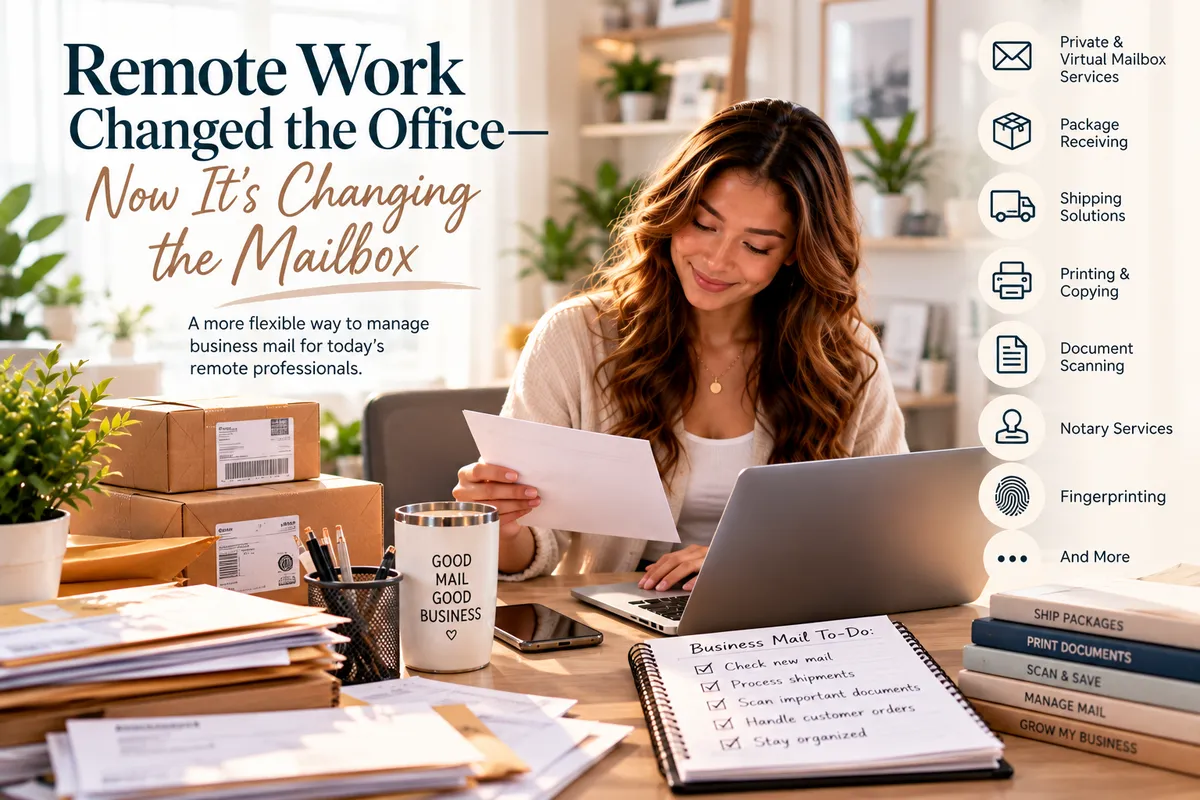
Remote Work Changed the Office—Now It's Changing the Mailbox
Remote Work Changed the Office—Now It's Changing the Mailbox
Introduction
The office has changed.
A laptop can replace a desk. Video calls can replace conference rooms. Cloud software can connect teams across different cities, states, and even countries.
But there's one part of running a business that hasn't disappeared: physical mail.
Contracts still arrive. Packages still need to be received. Official correspondence still needs attention. Business supplies still need somewhere to go.
And for remote workers, freelancers, consultants, and home-based entrepreneurs, that creates a new question:
If your business no longer needs a traditional office, does your business mail still need one?
The answer depends on how you operate. But as remote work continues to reshape business operations, mailing solutions are evolving to meet the needs of people who want flexibility without making their home the center of every business activity.
1. Remote Work Changed Where Business Happens
Traditional businesses often had a dedicated office where employees worked, documents were stored, and mail was received.
Today, business can happen almost anywhere.
A freelancer might work from a home office. A consultant might meet clients virtually. An online seller might manage orders from a laptop. A small team might operate entirely remotely.
These businesses may not need a conventional office lease, but they still have practical needs.
They may need to:
Receive business correspondence.
Accept packages and supplies.
Send documents and shipments.
Manage invoices and paperwork.
Keep personal and business activities separate.
Access important mail while traveling.
Remote work hasn't eliminated these responsibilities. It has changed how businesses handle them.
2. Your Home Address Isn't Automatically Your Best Business Address
When starting a business, using your home address can seem like the easiest option.
It may be convenient, especially during the early stages.
However, using a residential address for business purposes can create concerns about privacy, mail organization, and package deliveries.
Consider what happens when you use the same address for everything:
Personal bills arrive alongside business correspondence.
Customer or vendor mail comes to your home.
Business packages compete for space with personal deliveries.
Your residential address may appear on certain business materials or records.
Depending on your circumstances, a separate business mailing arrangement may help establish a clearer boundary between work and home.
Your business can operate from home without making every part of your home life part of your business operations.
Keep in mind that a mailing address does not automatically qualify as a physical business address, registered office, or legal address for every purpose. Confirm the requirements of any agency, bank, licensing organization, or platform before using one.
3. Private Mailboxes Are Becoming Useful Beyond Traditional Businesses
A private mailbox isn't just for companies with storefronts.
It can also be useful for individuals and businesses that need a dedicated place for appropriate mail and package deliveries.
Potential users include:
Freelancers and independent contractors
Consultants
Online business owners
Home-based entrepreneurs
Remote professionals
Small businesses without dedicated office space
People who travel frequently
A private mailbox can provide a consistent location for receiving eligible correspondence and packages, subject to the provider's services and policies.
For a growing business, it can also help create a more organized routine for handling physical mail.
4. What's the Difference Between a Private Mailbox and a Virtual Mailbox?
These terms are sometimes used interchangeably, but they can describe different services.
Private mailbox
A dedicated mailbox at a physical service location where eligible mail and packages can be received. Depending on the provider, you may collect items in person or arrange additional services.
Virtual mailbox
A service that may allow you to view mail-related information online, often through notifications or images of envelopes. Some providers offer additional options, such as mail forwarding or scanning, depending on the plan.
The right option depends on whether you prefer collecting mail in person, managing it remotely, receiving packages, or combining several of these needs.
Before signing up, confirm exactly what's included, how packages are handled, what forwarding costs, and whether additional fees apply.
5. Remote Workers Need More Than Digital Communication
A common misconception is that a fully digital business has no need for physical services.
In reality, remote professionals may still need to handle:
Signed documents
Original paperwork
Checks and business correspondence
Product samples
Office equipment
Customer returns
Shipping supplies
Printed marketing materials
Some documents can be scanned or shared digitally. Others may require original physical copies or specific handling.
The important thing is having a plan for both.
A digital workflow is stronger when it accounts for the physical tasks that still exist.
6. Package Receiving Matters for Home-Based Businesses
For online sellers and remote entrepreneurs, packages can be part of everyday operations.
Supplies arrive. Products need to be shipped. Returns may need attention. Equipment may require delivery.
If deliveries arrive while you're away, working with customers, or traveling, managing them can become inconvenient.
A package-receiving service may help by providing a designated location for eligible deliveries.
Before relying on one, check package size limits, carrier acceptance, notification procedures, storage periods, and pickup requirements.
7. A Business Mailing Address Can Support a More Professional Workflow
Professionalism isn't just about how a website looks or how an email is written.
It's also about having organized processes behind the scenes.
A consistent mailing arrangement can help a business manage correspondence without depending entirely on the owner's home routine.
It may support:
More organized mail handling
A consistent place for business correspondence
Better separation of personal and business mail
More predictable package management
A clearer process for handling incoming items
However, an address alone doesn't guarantee credibility or satisfy every business requirement. Choose an arrangement that matches your actual operational and compliance needs.
8. What About Digital Nomads and Frequent Travelers?
Remote work has made it easier for some professionals to work from different locations.
But physical mail doesn't automatically follow them.
A consultant traveling between cities may still need to receive business correspondence. An entrepreneur spending several weeks away may need a reliable way to manage incoming packages.
A private or virtual mailbox may help, depending on the services available.
Before traveling, consider:
Who will receive important mail?
How will you know when something arrives?
Can items be forwarded when necessary?
How will sensitive correspondence be handled?
What happens if a package requires prompt pickup?
Planning ahead can prevent physical mail from becoming an unexpected interruption.
9. Remote Work Still Requires Document Security
Changing where you work doesn't eliminate the responsibility to protect business information.
Physical mail and paper records may contain financial details, customer information, contracts, or other confidential material.
Remote businesses should establish clear procedures for:
Receiving and reviewing important mail
Storing sensitive documents
Scanning records when appropriate
Restricting access to confidential information
Backing up digital files
Securely disposing of records when permitted
If you use a mailbox or mail-handling service, review its policies for access, storage, privacy, and document handling.
And before destroying original paperwork, check whether retention requirements apply.
10. How to Choose the Right Mailing Solution
Not every remote business needs the same setup.
Use these questions to guide your decision.
Your business need | What to consider |
|---|---|
Keep business mail separate from home | Private mailbox services |
Manage mail while traveling | Virtual mailbox options |
Receive packages | Package acceptance and storage policies |
Send products or documents | Shipping and packing services |
Digitize paper correspondence | Document scanning options |
Maintain an official business address | Verify the specific address requirements first |
Protect confidential paperwork | Secure handling and disposal options |
The best solution is the one that fits your workflow, budget, and obligations—not simply the one with the most features.
11. The Future of Business Mail Is Flexible
The traditional office used to bundle many business functions together: workspace, mail delivery, document storage, package receiving, and administrative support.
Remote work has separated those functions.
Today, a business might work from home, store documents digitally, use a professional service for printing, and receive mail at a separate location.
This gives entrepreneurs more flexibility in how they operate.
The goal isn't to recreate a traditional office in another form.
It's to access the services you need without paying for or maintaining infrastructure you don't.
The modern business doesn't necessarily need a bigger office. It needs a smarter way to handle the work that still happens outside the screen.
How Ship It - Bay & Beyond Can Help
At Ship It - Bay & Beyond, we help remote professionals, home-based entrepreneurs, and small businesses manage the practical side of running a business.
Our services include:
Private mailboxes for eligible business and personal correspondence
Virtual mailbox services for customers seeking remote mail-management options
Package receiving for eligible deliveries
Professional packing and shipping for packages and documents
Printing and copying for business paperwork and marketing materials
Document scanning to help convert paper records into digital files
Secure document shredding for appropriate confidential records
Notary services for qualifying notarization needs
Fingerprinting for applicable employment and licensing requirements
Passport photos
Business formation support
U-Haul and moving supplies
Additional office services
Our location gives Tampa Bay individuals and businesses access to several practical services in one place.
Ship It - Bay & Beyond 5420 Central Ave, St. Petersburg, FL 33707Phone: 727-344-9052
Whether you're working from a spare bedroom, managing an online business, or traveling while serving clients, we can help with many of the physical tasks that remain part of modern business operations.
Proudly Serving the Tampa Bay Area
Ship It - Bay & Beyond proudly serves:
St. Petersburg
Tampa
Clearwater
Largo
Pinellas Park
Seminole
Gulfport
Kenneth City
Treasure Island
St. Pete Beach
Madeira Beach
Indian Rocks Beach
Indian Shores
Redington Beach
North Redington Beach
Redington Shores
Safety Harbor
Oldsmar
Dunedin
Palm Harbor
Tarpon Springs
Belleair
Belleair Bluffs
Lealman
Pinellas County
Hillsborough County
Surrounding communities
Whether you need professional packing and shipping, printing, a private or virtual mailbox, notary, fingerprinting, secure shredding, document scanning, copying, passport photos, business formation support, U-Haul, moving supplies, or other office services, Ship It! Bay & Beyond is your local resource for everyday business needs.
The Bottom Line
Remote work changed where business happens. Now it's changing how businesses handle mail, packages, and physical paperwork.
A dedicated mailing solution can help remote workers and entrepreneurs manage correspondence, separate business activity from home life, and organize deliveries without maintaining a traditional office.
The right choice depends on what you receive, how often you travel, and what your business or regulatory requirements demand.
