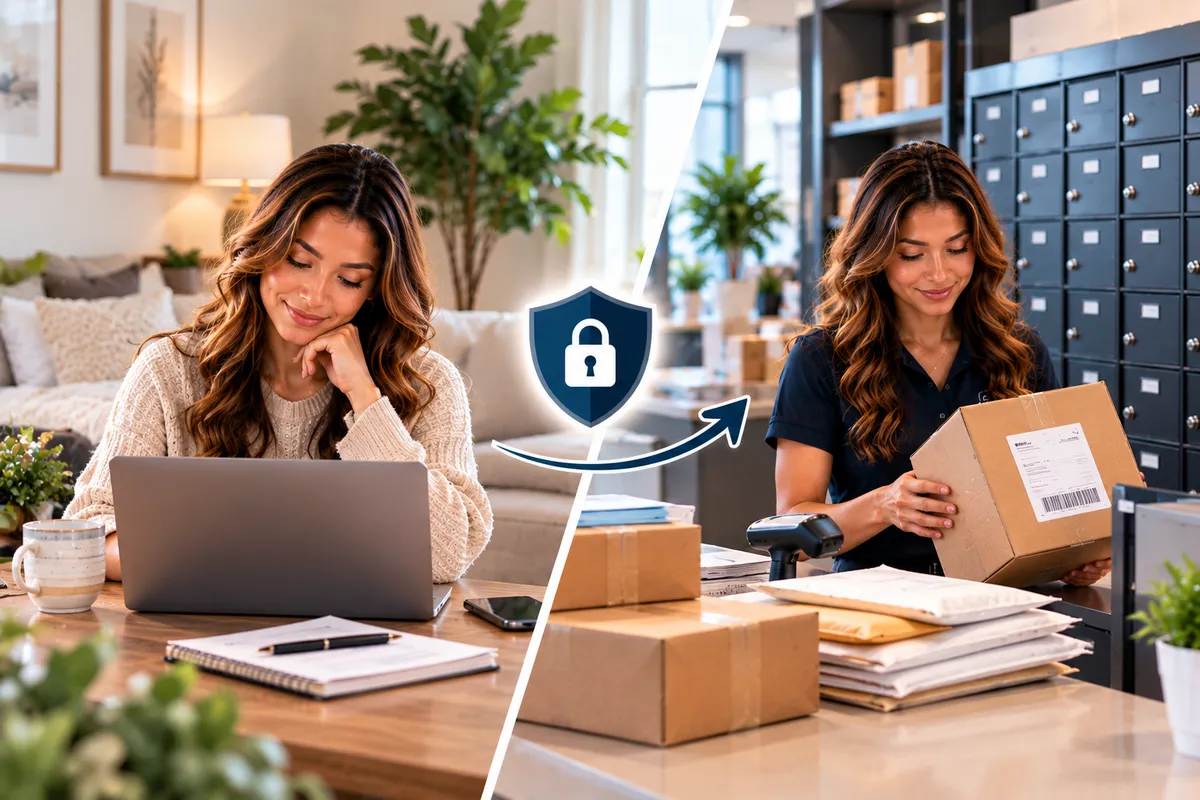
Your Home Office Is Private. Should Your Business Address Be Too?
Your Home Office Is Private. Should Your Business Address Be Too?
Introduction
Working from home has become a normal part of modern entrepreneurship.
Your laptop may be your office.
Your kitchen table may be your conference room.
Your spare bedroom may be your workspace.
But there's one question many home-based business owners don't think about until later:
Does your business really need to use your home address?
Your home is where you live.
It's where your family receives personal mail, where your belongings are kept, and where you expect a certain level of privacy.
Your business, meanwhile, may need an address for mail, packages, customer correspondence, vendors, and other operational purposes.
Those two things don't always have to be the same.
Why Are More Entrepreneurs Working From Home?
Modern technology has made it easier than ever to operate a business without a traditional office.
Entrepreneurs can manage:
Customer communication
Marketing
Scheduling
Payments
Documents
Meetings
Ecommerce
Accounting
Project management
from almost anywhere.
For many businesses, a dedicated office isn't necessary every day.
That can reduce overhead and give entrepreneurs more flexibility.
But working from home introduces another consideration:
How much of your home information should become part of your public business presence?
Your Home Address Can Reveal More Than You Think
When a residential address is used for business purposes, it can potentially appear in multiple places.
Depending on the business and how information is published, an address may show up on:
Business directories
Websites
Printed materials
Invoices
Shipping records
Online listings
Customer correspondence
Vendor records
That can create a connection between your business and your personal residence.
For some entrepreneurs, that's perfectly acceptable.
For others, maintaining separation is an important part of privacy.
Privacy Is a Business Consideration
Business owners often think about cybersecurity and password protection.
But privacy isn't only digital.
Physical information matters too.
Your address can tell people where a business operates—and when the business is home-based, it may also reveal where the owner lives.
Creating a distinction between your personal and business information can be one way to establish stronger boundaries.
This can be especially relevant for entrepreneurs who:
Work from home
Meet customers elsewhere
Travel frequently
Operate online businesses
Sell products online
Work remotely
Prefer not to publish their residence
A Business Mailing Address Can Create Separation
One option some entrepreneurs consider is using a private business mailing address rather than their residential address for appropriate business correspondence.
Depending on the service, a private mailbox may provide:
A dedicated mailing address
Mail receiving
Package receiving
A consistent business correspondence location
Additional separation between personal and business mail
This doesn't necessarily replace every type of address a business may be required to provide.
Different organizations can have different requirements.
But for ordinary business correspondence, a dedicated mailing solution may provide useful separation.
Private Mailbox vs. Home Address
Consider the difference.
Using Your Home Address
Advantages:
Simple
No additional service required
Convenient for personal mail
Potential concerns:
Less privacy
Business and personal mail can become mixed
Residential address may appear on business materials
Using a Private Mailbox
Potential advantages:
Separates business and personal mail
Provides a consistent mailing location
Can receive business correspondence and packages
May be more convenient for businesses that don't have traditional offices
The best choice depends on the business and how the address will be used.
What About a Virtual Mailbox?
Entrepreneurs who travel or work remotely may also consider virtual mailbox services.
Depending on the provider, services can include:
Mail notifications
Mail scanning
Digital access
Mail forwarding
Package handling
This can be particularly useful for business owners who aren't always physically present at their mailing location.
However, businesses should verify whether a particular virtual address meets the requirements of the organizations they need to work with.
A Mailing Address Isn't Always a Physical Business Address
This distinction is extremely important.
A mailing address does not necessarily mean:
You have a traditional office there
Customers can visit there
Employees work there
Your business operations occur there
It qualifies as a registered business location
Different institutions may require different types of addresses.
For example, banks, licensing agencies, government organizations, and other entities may have specific requirements.
Never assume that a mailing address can be substituted for every address requirement.
When in doubt, verify directly with the organization involved.
Your Website Doesn't Have to Tell Your Entire Story
Your customers need enough information to interact with your business.
But that doesn't necessarily mean every piece of personal information needs to be publicly displayed.
Consider what information your website actually needs to provide.
Depending on the business, that could include:
Business name
Service area
Phone number
Email address
Business hours
Mailing address
Physical location, if applicable
The exact requirements depend on your industry, location, and applicable rules.
The goal is to provide useful information without unnecessarily exposing personal information.
Think About Your Printed Materials, Too
A business address can appear in more places than your website.
Review your:
Business cards
Brochures
Flyers
Letterhead
Invoices
Packaging inserts
Shipping documents
Marketing materials
If you're trying to maintain a separation between your personal and business life, make sure you're not accidentally publishing your home address on older materials.
Package Receiving Is Another Consideration
Home-based businesses can quickly accumulate packages.
That can create practical problems.
You may have:
Customer returns
Inventory
Supplies
Vendor shipments
Business documents
Personal packages
Separating business package receiving from your home can make organization easier.
A professional package receiving service can provide another option for businesses that don't have a traditional office.
What About Customers Visiting Your Home?
Some home-based businesses operate comfortably with customers visiting their residence.
Others don't.
If your business model doesn't require customer visits, there may be little reason to make your home the default meeting location.
Instead, you might:
Meet clients at their location
Use appropriate professional meeting spaces
Operate primarily online
Use a separate business location when needed
The right arrangement depends on your business and industry.
Privacy Doesn't Mean Hiding Your Business
There's an important distinction between privacy and secrecy.
A professional business can have:
A public brand
A professional website
A business phone number
A dedicated mailing address
Clear contact information
while still keeping the owner's residential address private where appropriate.
You don't need to expose your personal location to prove that your business is legitimate.
Professionalism and Privacy Can Work Together
A business mailing address can also contribute to a more organized customer experience.
Imagine a home-based business that uses:
Business Name + Dedicated Mailing Address + Professional Email + Business Phone
That can create a clearer separation between the entrepreneur's personal life and business operations.
Again, the address itself doesn't determine whether a business is professional.
But having appropriate business systems can help.
Don't Forget Mail Security
A business mailing solution isn't only about privacy.
It's also about managing important correspondence.
Businesses may receive:
Checks
Contracts
Financial documents
Customer correspondence
Government notices
Vendor information
Packages
Having a consistent location for business mail can make it easier to manage these items separately from household correspondence.
What Should You Consider Before Choosing an Address?
Ask yourself:
Do I work primarily from home?
If yes, consider whether your residence needs to be publicly associated with your business.
Do customers need to visit me?
If not, you may have more flexibility.
Do I receive business packages?
If yes, package receiving may be important.
Do I travel frequently?
A virtual or mail-handling service may provide additional convenience.
Does a bank or government agency require a physical address?
Verify the specific requirement before choosing an address solution.
Do I want personal and business mail separated?
If yes, a dedicated mailing solution may help.
Don't Confuse Privacy With Compliance
This is one of the most important points.
Using a private mailbox or virtual mailbox can help with business correspondence and privacy, but it doesn't automatically satisfy every legal, tax, licensing, banking, or registration requirement.
Different agencies and organizations may require:
Residential address
Physical business address
Registered agent address
Mailing address
Principal business address
These terms aren't interchangeable.
If you're forming a business or dealing with a specific legal or regulatory requirement, verify the applicable rules or consult a qualified professional.
A Simple Home-Based Business Address Checklist
Before publishing your address, ask:
✓ Is this my personal residence?
✓ Does my business actually need this address publicly?
✓ Who will be able to see it?
✓ Do I receive business mail?
✓ Do I receive packages?
✓ Does my business need a physical operating location?
✓ Do banks, government agencies, or licensing organizations have specific address requirements?
✓ Would separating my business mail from my personal mail make my life easier?
These questions can help you make a more intentional decision.
Your Business Can Be Digital Without Being Completely Address-Free
A modern business may operate mostly online.
But physical needs still exist.
Businesses still receive:
Mail
Packages
Documents
Checks
Contracts
Printed materials
That's why the future of business isn't necessarily completely digital.
It's a combination of:
Digital tools + physical infrastructure + flexible services.
How Ship It - Bay & Beyond Can Help
At Ship It - Bay & Beyond, we help entrepreneurs and small businesses manage the physical side of their operations without necessarily maintaining a traditional office.
Our services include:
Private mailboxes
Virtual mailbox services
Package receiving
Professional packing and shipping
Printing
Copying
Document scanning
Secure document shredding
Notary services
Fingerprinting
Passport photos
Business formation support
U-Haul
Moving supplies
Office services
For home-based and remote businesses, having a dedicated place for business mail and packages can help create a practical separation between where you live and how you operate your business.
Proudly Serving the Tampa Bay Area
Ship It - Bay & Beyond proudly serves:
St. Petersburg
Tampa
Clearwater
Largo
Pinellas Park
Seminole
Gulfport
Kenneth City
Treasure Island
St. Pete Beach
Madeira Beach
Indian Rocks Beach
Indian Shores
Redington Beach
North Redington Beach
Redington Shores
Safety Harbor
Oldsmar
Dunedin
Palm Harbor
Tarpon Springs
Belleair
Belleair Bluffs
Lealman
Pinellas County
Hillsborough County
Surrounding communities
Whether you need professional packing & shipping, printing, a private or virtual mailbox, notary, fingerprinting, secure shredding, document scanning, copying, passport photos, business formation, U-Haul, moving supplies, or other office services, Ship It - Bay & Beyond is your trusted local partner.
The Bottom Line
Your home is more than a place where you work.
It's your personal space.
And for many entrepreneurs, maintaining a boundary between personal life and business life is increasingly important.
You don't necessarily need a giant office to create that separation.
You may simply need the right systems for handling your business mail, packages, documents, and communications.
Your business can be professional, accessible, and legitimate without making your home address the center of your public business presence.
The key is knowing which address your business actually needs for each purpose—and choosing the appropriate solution.
