Why Do Two Packages of the Same Weight Have Different Shipping Costs?
Ever Wonder Why Two Packages of the Same Weight Cost Different Amounts?
Introduction
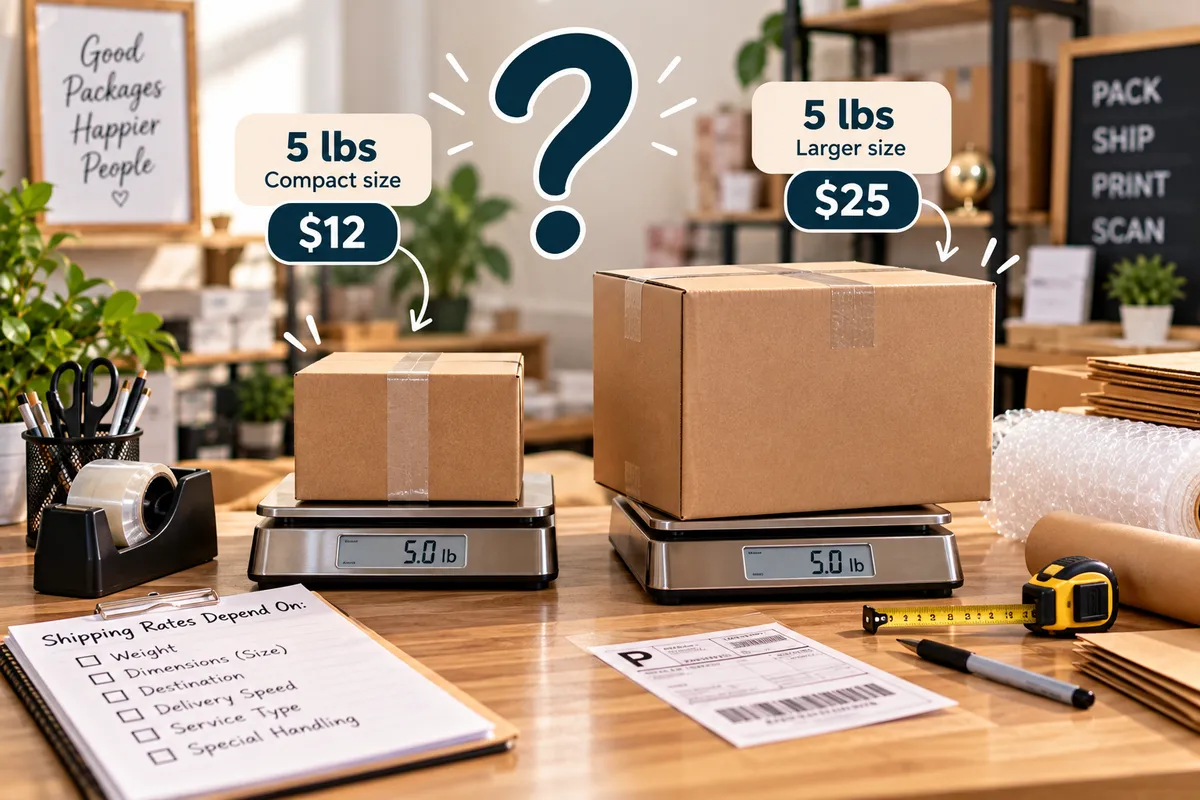
Have you ever packed two packages, weighed them, and discovered that they weigh exactly the same—but the shipping prices are completely different?
One costs $12 to ship. The other costs $25.
Your first thought might be: How does that make sense if both packages weigh the same?
It's a common question for online shoppers, small business owners, and anyone who ships packages regularly.
The truth is that shipping costs depend on more than the number on the scale. Carriers may also consider package dimensions, destination, delivery speed, service type, handling requirements, and other pricing factors.
Understanding how these factors work can help you make smarter shipping decisions, avoid surprises, and choose services that fit your budget.
Let's break it down.
1. Weight Isn't the Only Thing That Matters
It's easy to assume that a heavier package should always cost more to ship.
Weight is important, but it isn't the only factor carriers may use to calculate a shipping rate.
Consider these two packages:

Package A
5 lbs
Compact box containing books or small items

Package B
5 lbs
Large box containing lightweight cushions or bulky items
Both packages weigh five pounds, but Package B takes up considerably more space.
That difference can affect shipping costs because carriers must account for both the weight of packages and the space they occupy during transportation.
The takeaway: Two packages with identical weights can have very different shipping rates.
2. What Is Dimensional Weight?
One of the biggest reasons shipping prices differ is something called dimensional weight, sometimes shortened to DIM weight.
Dimensional weight is a pricing method that considers a package's size, not just its actual weight.
Why does this matter?
Imagine a truck filled with large boxes containing lightweight products. Even if the boxes don't weigh much, they occupy valuable space that could otherwise hold other shipments.
Dimensional weight helps carriers account for that space.
Depending on the carrier and service, the shipping charge may be based on the greater of the actual weight or dimensional weight, subject to applicable pricing rules.
How Is Dimensional Weight Calculated?
A common formula for certain U.S. domestic shipping services is:
\[ \text{Dimensional Weight} = \frac{L \times W \times H}{\text{DIM Divisor}} \]
Here:
\(L\) = package length
\(W\) = package width
\(H\) = package height
DIM divisor = a carrier- and service-specific number
For example, suppose a box measures 20 × 16 × 12 inches.
Its volume is:
\[ 20 \times 16 \times 12 = 3{,}840 \]
If a hypothetical carrier uses a dimensional divisor of 139:
\[ 3{,}840 \div 139 \approx 27.6 \]
The dimensional weight would be approximately 28 pounds if the carrier rounds up to a whole pound under its applicable rules.
Even if the package weighs only five pounds on a scale, its dimensional weight could be substantially higher.
Important: The divisor, rounding rules, dimensional measurements, and billable-weight rules vary by carrier, service, and shipment type. This example illustrates the calculation and is not a quote for any specific carrier.
3. The Destination Can Change the Price
Two packages with identical dimensions and weight may still have different shipping costs because they're going to different destinations.
Shipping from St. Petersburg, Florida, to a nearby city may cost less than shipping to a distant state.
International shipments can involve additional factors, such as customs documentation, duties, taxes, and international service requirements.
Rates may also vary based on the delivery zone used by the carrier.
Before comparing prices, make sure you're comparing shipments going to the same destination.
A useful tip
When requesting a shipping quote, have the complete destination ZIP code or postal code ready. It can make a meaningful difference in the rate displayed.
4. Delivery Speed Matters
How quickly does your package need to arrive?
A standard delivery service may be less expensive than an expedited or overnight option.
For example, a business shipping a product to a customer next week may have more flexibility than someone sending documents that must arrive tomorrow.
Shipping services may differ in:
Estimated delivery time
Guaranteed delivery commitments, where offered
Tracking features
Pickup and delivery options
Eligibility for specific package types
Faster isn't always better if the package doesn't need to arrive urgently.
Before selecting a service, consider the actual deadline rather than automatically choosing the fastest option.
The smartest shipping decision balances delivery needs with cost.
5. Packaging Can Affect Your Shipping Bill
The box you choose can influence the final shipping price.
A package that is unnecessarily large may increase dimensional weight. Poor packaging may also leave the contents vulnerable to damage.
For many shipments, the goal is to use the smallest suitable box that provides adequate protection.
However, smaller isn't automatically better if it leaves fragile items without enough cushioning.
Consider these practical packing tips:
Choose a box appropriate for the item's dimensions.
Avoid excessive empty space.
Use protective materials suited to the contents.
Prevent items from moving freely inside the box.
Measure the outside dimensions of the completed package.
Weigh the package after packing.
Remember that packaging materials add weight and can change the final measurements.
A compact, properly protected package can help you avoid paying for unnecessary space while keeping the contents safer during transit.
6. Special Handling Can Affect Shipping Costs
Not every package can be handled like an ordinary cardboard box.
Some shipments may require special services or handling because of their size, shape, contents, or delivery requirements.
Examples may include:
Oversized packages
Long or unusually shaped items
Certain fragile shipments
Heavy packages
Restricted or regulated items
Packages requiring additional delivery arrangements
Depending on the carrier, shipment, and service, additional fees or restrictions may apply.
If you're shipping something unusual, describe the item accurately when requesting a quote.
That can help identify suitable services and reduce the risk of unexpected charges.
7. Carrier Pricing Rules Aren't All the Same
Different carriers have different pricing structures.
They may use different:
Dimensional-weight divisors
Weight-rounding rules
Size limits
Service zones
Delivery commitments
Additional fees
Packaging requirements
This is one reason comparing only the advertised base price can be misleading.
A lower starting rate doesn't necessarily mean a lower final cost for your specific shipment.
When comparing services, use the same package dimensions, weight, origin, destination, and delivery requirements.
Also check whether the quote includes applicable additional charges.
Compare the complete shipment—not just the headline rate.
8. How Small Businesses Can Avoid Overpaying for Shipping
For online sellers and small businesses, shipping costs can affect profit margins.
If you're shipping dozens or hundreds of packages, even modest differences in cost can add up.
Here are practical ways to improve your shipping process.
Review Your Packaging
Measure your most commonly shipped products and identify whether you're using boxes that are larger than necessary.
Standardize Box Sizes
Having a small selection of appropriate box sizes can simplify packing and help control material costs.
Weigh Completed Packages
Calculate the weight after adding the product, protective materials, box, and other packaging.
Compare Suitable Services
Look at available options based on the package's actual requirements.
Include Shipping in Your Pricing Decisions
Review shipping expenses when calculating product margins and setting delivery charges.
Track Your Shipping Costs
Record shipping expenses by product type, package size, destination, or service.
This can help you identify where costs are increasing and where changes may make a difference.
9. Before You Ship, Check These Five Things
Use this quick checklist to prepare your package for a more accurate shipping quote.
Shipping Cost Checklist
Ready to ship?
0 of 5
Measure the outside length, width, and height
Weigh the fully packed package
Confirm the destination ZIP or postal code
Choose a delivery timeframe that fits your needs
Check carrier restrictions and potential additional fees
These details can help you compare options more accurately and understand why one service may cost more than another.
How Ship It - Bay & Beyond Can Help
At Ship It - Bay & Beyond, we help individuals, online sellers, and small businesses manage their shipping and packing needs.
Our services include:
Professional packing and shipping for packages and business shipments
Packing supplies for different shipping and moving needs
Package receiving for eligible deliveries
Private mailboxes for appropriate personal and business correspondence
Virtual mailbox services for customers seeking remote mail-management options
Printing and copying for business documents and shipping-related paperwork
Document scanning to help digitize appropriate records
Secure document shredding for confidential paper records that no longer need to be retained
Notary services
Fingerprinting
Passport photos
Business formation support
U-Haul and moving supplies
Additional office services
If you're unsure how to prepare a shipment, our team can help you explore the packing and shipping options available for your package.
Bring the item's dimensions, approximate weight, destination, and delivery timeframe when possible. These details help support a more informed comparison of available services.
Ship It - Bay & Beyond
5420 Central Ave, St. Petersburg, FL 33707
Phone: 727-344-9052
Proudly Serving the Tampa Bay Area
Ship It - Bay & Beyond proudly serves:
St. Petersburg
Tampa
Clearwater
Largo
Pinellas Park
Seminole
Gulfport
Kenneth City
Treasure Island
St. Pete Beach
Madeira Beach
Indian Rocks Beach
Indian Shores
Redington Beach
North Redington Beach
Redington Shores
Safety Harbor
Oldsmar
Dunedin
Palm Harbor
Tarpon Springs
Belleair
Belleair Bluffs
Lealman
Pinellas County
Hillsborough County
Surrounding communities
Whether you need professional packing and shipping, printing, a private or virtual mailbox, notary, fingerprinting, secure shredding, document scanning, copying, passport photos, business formation support, U-Haul, moving supplies, or other office services, Ship It - Bay & Beyond is your local resource for everyday shipping and business needs.
The Bottom Line
Two packages can weigh exactly the same and still have very different shipping prices.
The reason may be their dimensions, destination, delivery speed, carrier pricing rules, or additional handling requirements.
Understanding these factors helps you make more informed decisions before shipping.
Measure carefully. Choose suitable packaging. Compare services using accurate shipment details. And don't assume that the lowest advertised rate will always be the least expensive option for your package.
