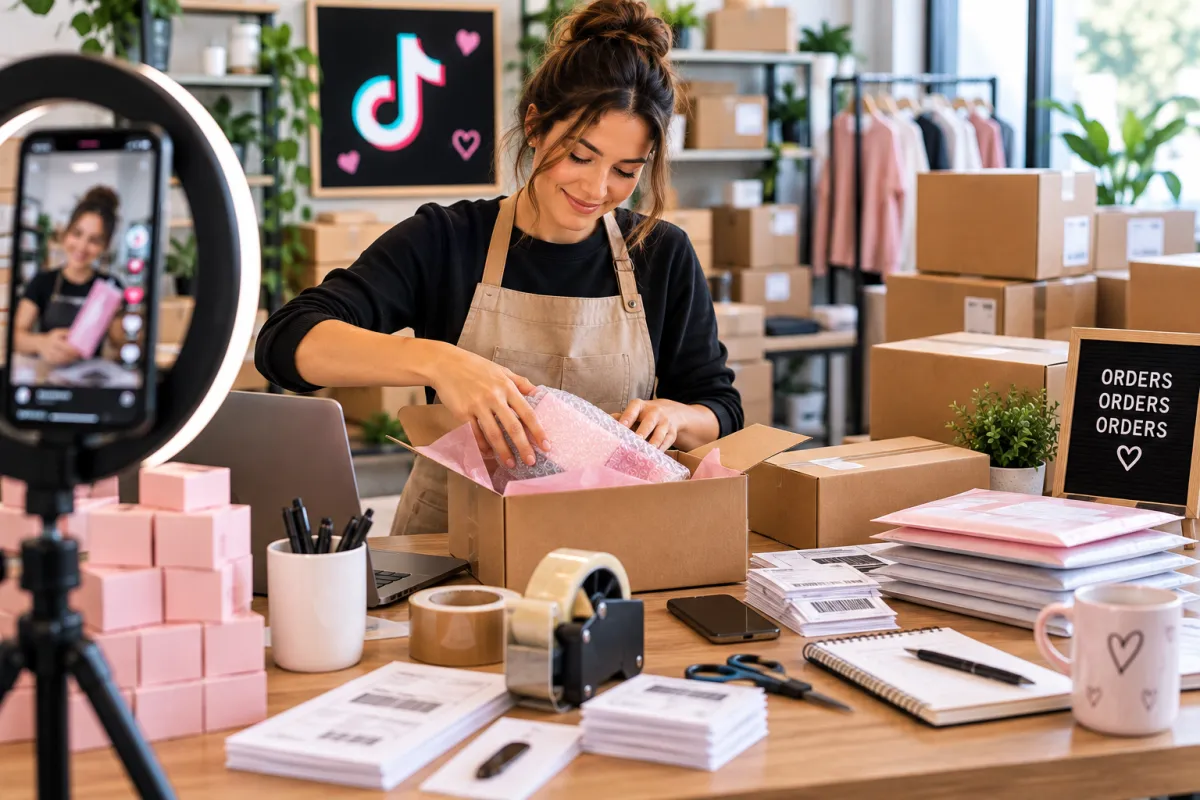
TikTok Made Them Buy It—Now Someone Has to Ship It | Small Business Shipping Guide
TikTok Made Them Buy It—Now Someone Has to Ship It
One video.
One product.
One creator saying, "You need this."
Suddenly, thousands of people are clicking Buy Now.
For a small business, that's the dream.
A product goes viral. Orders start coming in. Notifications don't stop. Inventory moves. Your audience grows.
But there's a part of viral success that doesn't happen on a screen:
Someone has to pack all those orders.
Someone has to print the labels.
Someone has to choose the right packaging.
Someone has to make sure the products are protected.
And someone has to get those packages moving.
Because going viral can create demand overnight.
Fulfillment has to keep up.
Social Media Can Create Demand Faster Than Ever
Platforms like TikTok have changed how consumers discover products.
Instead of searching for something they already want, shoppers can discover a product while watching entertainment, following creators, or browsing recommendations.
That can turn a relatively unknown product into a sudden sales opportunity.
For small businesses, this creates an exciting possibility:
Your next customer might discover you before they've ever heard of your business.
But increased visibility can also create an operational challenge.
What happens when your normal five-orders-a-day business suddenly has fifty?
Or five hundred?
Your marketing may be ready.
Your website may be ready.
Your inventory might even be ready.
But is your shipping process ready?
1. Viral Sales Can Expose Weak Systems
A sudden increase in orders sounds like a great problem to have.
And it is—but it's still a problem that needs solving.
A business that isn't prepared for a sales spike may experience:
Packing delays
Shipping mistakes
Inventory confusion
Incorrect addresses
Poor packaging
Delayed customer communication
Missed shipping deadlines
Increased returns
The lesson?
Don't just prepare your product to go viral. Prepare your operation to handle success.
2. Your Packaging Becomes Part of the Customer Experience
When someone discovers your product through a video, their expectations don't stop when they click purchase.
They've already experienced your brand through:
Your visuals
Your videos
Your product presentation
Your creator partnerships
Your social media personality
Then the package arrives.
And suddenly, the packaging becomes part of the experience.
A thoughtfully packed order can reinforce the impression your customer already has of your business.
A poorly protected product can do the opposite.
The unboxing is part of the journey.
3. The Right Box Matters
It can be tempting to use whatever box happens to be available.
But packaging should be appropriate for the product.
Consider:
Product size
Product weight
Fragility
Shape
Number of items
Cushioning requirements
A box that's much larger than the product may require additional protective material.
A box that's too small may place pressure on the contents.
A weakened reused box may not provide the protection you need.
The cheapest box isn't necessarily the cheapest solution if the product arrives damaged.
4. Don't Let Empty Space Become a Shipping Problem
Imagine your product bouncing around inside the box.
During transportation, packages can be handled, stacked, moved, and transported through multiple stages of a carrier network.
If the contents can move excessively, they're potentially more vulnerable to damage.
Appropriate cushioning can help reduce that movement.
Depending on the product, this might include:
Packing paper
Bubble cushioning
Foam
Air-filled cushioning
Inserts
Dividers
Corner protection
The goal isn't to fill the box with as much material as possible.
The goal is controlled protection.
5. Your Shipping Label Is Part of the Process
A beautifully packaged product isn't much help if the shipment information is wrong.
Before sending orders, establish a process for checking:
Customer name
Delivery address
Return address
Shipping service
Package information
Tracking information
For businesses processing a large number of orders, small errors can multiply quickly.
One incorrect address is frustrating.
Dozens of incorrect addresses can become a serious operational problem.
6. Viral Sales Can Change Your Shipping Volume Overnight
Your normal shipping workflow may be designed for a predictable number of orders.
Then a video takes off.
Suddenly:
10 orders → 50 orders → 200 orders
The exact numbers don't matter.
The lesson does.
A sales spike changes your workload.
You may need more:
Boxes
Mailers
Tape
Labels
Packing materials
Storage space
Staff time
This is why businesses should think about packaging and fulfillment before a major promotion or product launch.
7. Know Your Packaging Costs Before You Go Viral
Many businesses calculate:
Product cost + selling price = profit
But shipping-related expenses can include much more.
Consider:
Box or mailer
Cushioning
Tape
Labels
Printing
Shipping charges
Labor
Returns
Replacement shipments
Packaging costs should be part of your overall pricing and fulfillment calculations.
A product can go viral and still create financial problems if fulfillment costs weren't considered.
8. Shipping Speed Is Part of Customer Expectations
Social media moves incredibly fast.
A customer sees a product.
They become excited.
They order.
Then they start waiting.
That means businesses need to communicate realistic expectations around:
Processing time
Handling time
Shipping time
Tracking
Potential delays
Don't promise a delivery timeline you can't consistently support.
Clear expectations can prevent unnecessary customer frustration.
9. Don't Confuse Processing Time With Shipping Time
This distinction is especially important for growing online businesses.
Processing time is the time your business needs to prepare an order.
Transit time is the time the carrier takes to transport it.
For example:
Order placed → Business processes order → Package handed to carrier → Package travels → Delivery
A customer may not understand why their package hasn't arrived if they don't know where it is in this process.
Clear communication helps.
10. Tracking Information Can Reduce "Where Is My Order?" Messages
When customers receive tracking information, they have a way to monitor the shipment.
This can reduce some unnecessary customer-service questions.
But tracking doesn't always update instantly.
A temporary gap doesn't automatically mean a package is lost.
If a shipment appears delayed, businesses should review the carrier information and follow the appropriate process.
Good shipping communication continues after the package leaves your hands.
11. Protect the Product—and Your Reputation
A damaged product can become more than a replacement cost.
It can become:
A customer complaint.
A return.
A refund.
A negative review.
A social media post.
When customers discover products through social media, their expectations can be highly visual.
That makes the physical delivery experience especially important.
Your online reputation and your shipping experience are connected.
12. Don't Forget the Return Process
If your product becomes popular, returns may increase too.
Before a sales spike, make sure you understand:
Your return policy
How customers initiate returns
Where returned products go
How returned products are inspected
How refunds are handled
How replacement orders are shipped
A business shouldn't build only an order-out process.
It needs a plan for orders coming back, too.
13. Shipping Can Be a Brand-Building Opportunity
A package doesn't have to be complicated to feel professional.
Small details can make a difference:
Clean packaging
Secure sealing
Appropriate protection
Accurate labeling
Organized presentation
For certain brands, businesses may also incorporate:
Thank-you cards
Branded inserts
Product instructions
Care information
The goal isn't to add unnecessary materials.
It's to make the package feel intentional.
14. Don't Overpackage Just for the "Aesthetic"
There's another side to this.
Social media can make elaborate packaging look exciting.
But packaging decisions should still make operational sense.
Too much packaging can increase:
Material costs
Package dimensions
Shipping costs
Waste
Packing time
Your packaging should balance:
Protection + presentation + cost + efficiency.
15. Your First Viral Moment Is a Learning Opportunity
Maybe the first time your product takes off, everything isn't perfect.
That's okay.
Document what happened.
Ask:
Where did we slow down?
What ran out?
What caused mistakes?
What did customers ask about?
Which products were hardest to pack?
How much time did fulfillment actually take?
Then improve the system.
The goal isn't just surviving one viral moment.
It's building a business that can handle the next one better.
16. Create a Repeatable Packing Workflow
Instead of every employee packing orders differently, create a consistent process.
For example:
Step 1: Pick
Retrieve the correct product.
Step 2: Inspect
Check the item before packing.
Step 3: Protect
Add appropriate cushioning or protective materials.
Step 4: Pack
Place the item securely inside the package.
Step 5: Seal
Secure the package appropriately.
Step 6: Label
Apply the correct shipping label.
Step 7: Verify
Check the shipment before it leaves.
Step 8: Ship
Move the package into the carrier process.
A repeatable workflow reduces unnecessary decisions and can make training easier.
17. Know When to Get Help
There's nothing wrong with admitting that fulfillment has become too much.
If your business is spending hours every day:
Packing orders
Printing labels
Buying packaging supplies
Organizing shipments
Handling returns
ask whether those activities are taking you away from higher-value work.
Your time may be better spent on:
Product development
Marketing
Customer relationships
Sales
Strategy
Growth
You built the business. You don't necessarily have to do every task inside it.
18. The "TikTok Made Me Buy It" Moment Doesn't End With the Purchase
A customer journey might look like:
Discover → Watch → Click → Buy → Receive → Open → Use → Share
Shipping sits right in the middle.
That makes fulfillment part of the customer experience—not just an administrative task.
If the product arrives late, damaged, poorly packaged, or with confusing information, the experience can change.
If it arrives safely, professionally, and on time, the positive impression can continue.
19. Build Systems Before You Need Them
One of the best lessons for small businesses is simple:
Don't wait for the problem to become urgent.
Before launching a product or promotion, ask:
Do we have enough packaging?
Can we handle a sudden increase in orders?
Who is responsible for fulfillment?
How will we manage tracking?
What happens if inventory runs low?
What happens if packages are returned?
What happens if the carrier experiences delays?
The answers don't need to be complicated.
They just need to exist.
20. Social Commerce Is About More Than Social Media
The marketing may happen online.
The purchase may happen online.
The customer discovery may happen online.
But fulfillment happens in the real world.
That means successful social commerce requires more than good content.
It requires coordination between:
Marketing + Inventory + Packaging + Shipping + Customer Service
A viral post can create demand. A reliable system turns that demand into a sustainable business.
A Simple Viral-Sales Shipping Checklist
Before your next major promotion, review:
Marketing
☐ Product information is accurate
☐ Pricing is clear
☐ Shipping expectations are clear
Inventory
☐ Enough product is available
☐ Inventory is organized
☐ Reordering plans are established
Packaging
☐ Appropriate boxes or mailers
☐ Protective materials
☐ Shipping tape
☐ Labels
☐ Packing supplies
Fulfillment
☐ Orders can be processed efficiently
☐ Shipping workflow is documented
☐ Tracking is available
☐ Return process is understood
Customer Service
☐ Processing times are communicated
☐ Common shipping questions are anticipated
☐ Delays have a communication plan
How Ship It - Bay & Beyond Can Help
When an online business starts getting more orders, the physical side of fulfillment can become a bigger part of the workload.
Ship It - Bay & Beyond can help with several of those real-world tasks.
Professional Packing & Shipping
Get assistance preparing packages with appropriate packing materials and shipping options for your needs.
Printing & Copying
Print shipping documents, labels, inserts, promotional materials, business cards, and other business essentials.
Package Receiving
Convenient receiving options for eligible packages.
Private Mailboxes
A dedicated mailing solution for business correspondence and eligible packages, subject to applicable requirements.
Virtual Mailboxes
Flexible mail-management options for entrepreneurs and businesses that aren't always in one location, depending on available service features.
Document Scanning
Digitize eligible paperwork for easier organization and access.
Secure Document Shredding
Securely dispose of confidential business paperwork after confirming it no longer needs to be retained.
Notary Services
Notary services for eligible business and personal documents.
Fingerprinting
Fingerprinting services for eligible employment, licensing, and other requirements.
Passport Photos
Professional passport photo services for eligible applications.
Business Formation Assistance
Support for entrepreneurs handling practical business setup and administrative needs.
Proudly Serving the Tampa Bay Area
Ship It - Bay & Beyond proudly serves individuals, families, entrepreneurs, creators, online sellers, and businesses throughout the Tampa Bay region, including:
St. Petersburg
Tampa
Clearwater
Largo
Pinellas Park
Seminole
Gulfport
Kenneth City
Treasure Island
St. Pete Beach
Madeira Beach
Indian Rocks Beach
Indian Shores
Redington Beach
North Redington Beach
Redington Shores
Safety Harbor
Oldsmar
Dunedin
Palm Harbor
Tarpon Springs
Belleair
Belleair Bluffs
Lealman
Pinellas County
Hillsborough County
Surrounding communities
Whether you need professional packing and shipping, printing, private mailbox services, virtual mailbox services, package receiving, notary services, fingerprinting, secure shredding, document scanning, copying, passport photos, business formation, or office services, Ship It! Bay & Beyond is your trusted local partner.
The Bottom Line
TikTok can make a product famous overnight.
But viral attention is only the beginning.
The real test comes afterward.
Can you:
Process the orders?
Protect the products?
Ship them accurately?
Communicate with customers?
Handle returns?
Keep up when demand increases?
Because customers don't just remember the video that convinced them to buy.
They remember what happened after they clicked "Buy."
Social media can create the demand.
Your business systems have to deliver the experience.
So if you're hoping your next product goes viral, don't just ask:
"How do we get more views?"
Ask:
"What happens if everyone actually buys it?"
That's the question that can turn viral attention into sustainable business growth.
Frequently Asked Questions
How does TikTok affect small business shipping?
When social media increases product visibility, order volume can rise quickly. That can put pressure on inventory, packaging, fulfillment, shipping, and customer service.
How can a small business prepare for a viral product?
Prepare packaging supplies, establish a repeatable fulfillment process, organize inventory, communicate realistic processing times, and have a plan for tracking, returns, and customer questions.
Why is packaging important for TikTok products?
Packaging protects the product during transportation and can also contribute to the customer's overall experience with the brand.
Should small businesses use professional packing services?
Professional packing assistance can be useful when order volume increases, products are fragile or difficult to package, or business owners want to spend more time on higher-value activities.
How can businesses reduce shipping mistakes?
Use a consistent workflow that includes picking the correct product, inspecting it, packaging it appropriately, verifying the shipping information, and checking the shipment before it leaves.
Is shipping part of the customer experience?
Absolutely. The customer experience continues after the purchase. Delivery speed, packaging quality, product condition, tracking communication, and how returns are handled can all influence how customers perceive a business.
