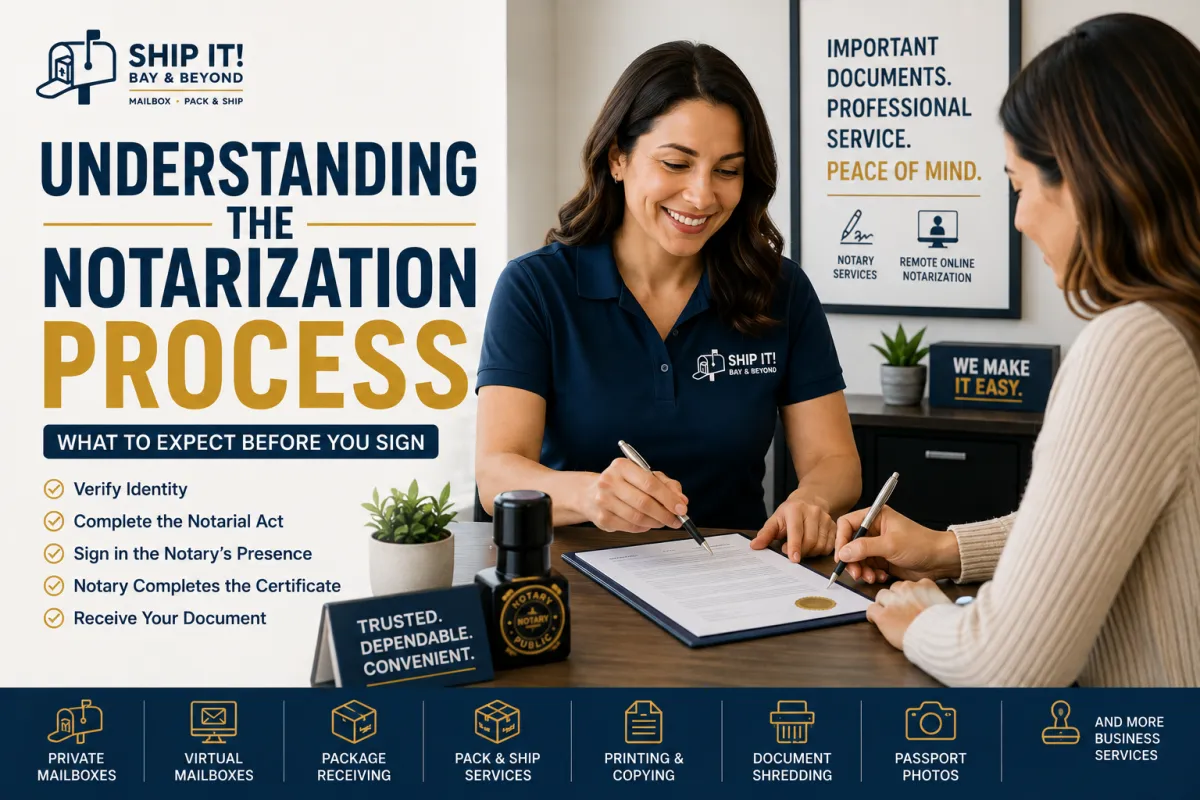
Understanding the Notarization Process: What to Expect Before You Sign
Understanding the Notarization Process: What to Expect Before You Sign
Signing an important document can feel stressful—especially when someone tells you, "This needs to be notarized."
What does that actually mean?
Do you sign before meeting the notary? What identification do you need? Does the notary review your document? Can any document be notarized?
Understanding the notarization process can make your appointment much easier and help you arrive prepared.
At its core, notarization is a formal process used to help verify a signer's identity and properly document a notarial act. The exact requirements depend on the type of document, the notarial act, and the laws of the state where the notarization occurs.
For Florida notarizations, the state requires the signer to personally appear before the notary and be properly identified.
Let's break down what you should know.
What Is Notarization?
Notarization is a process performed by a commissioned notary public.
A notary may perform certain authorized acts, such as taking an acknowledgment or administering an oath, depending on the document and circumstances.
The notary's role is not to approve the contents of your document or provide legal advice.
Instead, the notary follows applicable requirements for identity verification, personal appearance, the notarial act, and completion of the notarial certificate.
When Might You Need a Notary?
Notarization is commonly associated with documents involving important personal, financial, business, or legal transactions.
Examples can include:
Affidavits
Powers of attorney
Real estate documents
Business documents
Contracts
Certain applications
Sworn statements
Some estate-planning documents
Other documents that specifically require notarization
Not every document requires notarization, so it's important to follow the instructions provided by the organization requesting your document.
How Does the Notarization Process Work?
While requirements can vary, a typical notarization generally involves several important steps.
1. Bring the Complete Document
Bring the document that needs to be notarized.
Before your appointment, check whether:
All required pages are included.
The document is complete.
Names are spelled correctly.
Required fields are filled out.
You know where you're expected to sign.
Don't assume the notary can tell you how to complete the legal document.
A notary generally cannot provide legal advice or choose the appropriate legal wording for you.
2. Bring Acceptable Identification
The notary needs to establish your identity according to applicable law.
In Florida, a signer may be identified through personal knowledge or an acceptable form of identification.
Because identification requirements can vary, it's best to confirm what your notary accepts before your appointment.
3. Appear Before the Notary
This is one of the most important parts of the process.
For a standard Florida notarization, the signer must personally appear before the notary. A phone call or another person appearing on the signer's behalf does not substitute for the required personal appearance.
The notary will complete the required identity and notarial procedures before completing the notarial certificate.
4. Complete the Required Notarial Act
The notary will determine which authorized notarial act applies based on the document and the signer's request.
Two common types are:
Acknowledgment
An acknowledgment generally involves the signer acknowledging that they executed or signed the document.
Jurat
A jurat involves the signer taking an oath or affirmation regarding the truthfulness of the contents of the document and signing in the notary's presence.
The appropriate act depends on the document and applicable requirements.
5. Sign the Document Properly
One common mistake is signing a document before understanding the signing instructions.
If the document requires your signature to be completed in the presence of the notary, wait until you're instructed to sign.
For Florida notarizations, personal appearance and proper execution are important parts of the process.
If you're unsure whether you should sign beforehand, ask the notary before signing.
6. The Notary Completes the Certificate
The notarial certificate documents the notarial act.
Florida's Department of State explains that a notarial certificate includes essential information such as the location, type of notarial act, date, signer's name, identification information or basis for identification, notary signature, printed or stamped name, and official seal.
This is an important part of completing the notarization correctly.
7. Review the Completed Document
Before leaving your appointment, take a moment to make sure you have everything you need.
Check that:
The document has been signed where required.
The notarial certificate has been completed.
The notary's seal is present when required.
All pages are together.
You understand where the completed document needs to go next.
If the document is being submitted to a government agency, court, lender, employer, or another organization, follow that organization's instructions.
What a Notary Does—and Doesn't Do
Understanding the notary's role can prevent confusion.
A Notary Generally Helps With:
✔ Verifying identity
✔ Completing an authorized notarial act
✔ Administering an oath or affirmation when required
✔ Completing the notarial certificate
✔ Applying the required official seal
A Notary Generally Does NOT:
✘ Give legal advice
✘ Choose legal language for your document
✘ Decide whether a contract is fair
✘ Guarantee that your document will be accepted by another organization
✘ Replace an attorney when legal advice is needed
A notary's job is to perform the authorized notarial act—not to act as your attorney.
What Should You Bring to a Notary Appointment?
Being prepared can make your appointment faster and easier.
Consider bringing:
📄 The Complete Document
Bring the original document that needs notarization unless the requesting organization tells you otherwise.
🪪 Acceptable Identification
Bring the identification required by the applicable notary rules.
👥 Additional Signers or Witnesses
If your document requires witnesses, confirm in advance who must be present. Requirements vary by document.
💳 Payment
Check the notary's accepted payment methods and applicable fees before your appointment.
📋 Instructions From the Requesting Organization
If a bank, government agency, attorney, title company, employer, or another organization provided special instructions, bring them with you.
Common Notarization Mistakes to Avoid
Mistake #1: Forgetting Your Identification
Without acceptable identification or another legally permitted basis for identification, the notary may not be able to complete the notarization.
Mistake #2: Signing Too Early
Some documents require the signer to sign in the notary's presence.
When in doubt, wait and ask.
Mistake #3: Bringing an Incomplete Document
Missing information or pages can delay the process.
Have the document ready before your appointment, but don't fill in or alter information you're unsure about just to make it look complete.
Mistake #4: Expecting the Notary to Explain the Legal Document
A notary can explain the notarial process, but that doesn't mean they can interpret your contract or advise you about your legal rights.
If you have questions about what you're agreeing to, consult an appropriately qualified attorney.
Mistake #5: Assuming Every Notary Can Handle Every Situation
Notarial requirements vary by state and document type.
If you're dealing with a specialized transaction, international document, remote online notarization, or another situation with additional requirements, confirm that the notary is authorized and equipped to handle it.
What About Remote Online Notarization?
Technology has also changed how some notarizations are performed.
Florida recognizes Remote Online Notaries, and the Florida Department of State provides specific information and requirements for online notarization.
Remote Online Notarization, commonly called RON, allows an authorized notary to perform certain notarization services through an approved online process.
However, not every document or situation should automatically be assumed to qualify for RON.
Always confirm the requirements of the document recipient and the applicable law.
What If Your Document Will Be Used Internationally?
Notarization and apostille are not the same thing.
If a notarized document will be used in another country, it may need additional authentication or an apostille depending on the destination and document.
The Florida Secretary of State is the competent authority for Florida apostilles.
If you're preparing an international document, check the requirements before your notarization appointment so you don't discover later that additional steps are necessary.
How Ship It - Bay & Beyond Can Help
At Ship It - Bay & Beyond, we make essential personal and business services more convenient by bringing multiple solutions together in one location.
Our services include:
Notary Services
Remote Online Notarization (RON)
Professional Packing & Shipping
Private Mailboxes
Virtual Mailbox Services
Printing & Copying
Document Scanning
Secure Document Shredding
Fingerprinting
Passport Photos
Business Formation Assistance
Office & Business Support Services
Whether you're preparing a personal document, handling business paperwork, or completing an important transaction, our goal is to make the process as convenient and straightforward as possible.
Proudly Serving the Tampa Bay Area
Ship It - Bay & Beyond proudly serves individuals, families, entrepreneurs, professionals, and businesses throughout the Tampa Bay area, including:
St. Petersburg
Tampa
Clearwater
Largo
Pinellas Park
Seminole
Gulfport
Kenneth City
Treasure Island
St. Pete Beach
Madeira Beach
Indian Rocks Beach
Indian Shores
Redington Beach
North Redington Beach
Redington Shores
Safety Harbor
Oldsmar
Dunedin
Palm Harbor
Tarpon Springs
Belleair
Belleair Bluffs
Lealman
Pinellas County
Hillsborough County
And surrounding communities.
Whether you need notary services, Remote Online Notarization, mobile notary services, professional packing and shipping, private or virtual mailboxes, printing, copying, fingerprinting, document scanning, secure shredding, passport photos, or business support, Ship It! Bay & Beyond is your trusted local partner for convenient solutions.
The Bottom Line
The notarization process doesn't have to be confusing.
The key is to prepare your document, bring the required identification, appear before the notary, follow the signing instructions, and make sure the notarial certificate is properly completed.
And remember: a notary can help with the notarization process, but they aren't a substitute for legal advice.
If you're unsure whether your document needs notarization—or what type of notarization is required—check with the organization requesting the document or consult an appropriate legal professional.
At Ship It - Bay & Beyond, we're here to make important personal and business tasks easier, one service at a time.
What's Your Answer?
Have you ever had a document notarized?
Yes, many times
Once or twice
Not yet
I've used online notarization
I'm not sure if my document needs it
Share your experience in the comments!
Frequently Asked Questions
How long does notarization take?
The time can vary depending on the document, number of signers, identification requirements, witnesses, and other circumstances. Having everything prepared beforehand can help make the appointment more efficient.
Do I sign before meeting the notary?
Not necessarily. Some documents require signing in the notary's presence. If you're unsure, wait and ask the notary before signing.
What identification do I need for notarization?
Identification requirements depend on applicable law. In Florida, a notary may rely on personal knowledge or an acceptable form of identification.
Can a notary explain my legal document?
A notary can explain the notarial process but generally should not provide legal advice or interpret the legal effect of your document. If you have legal questions, consult an attorney.
Can documents be notarized online?
Florida has a Remote Online Notary system with specific requirements. Whether your particular document can be notarized remotely depends on applicable law and the requirements of the organization receiving the document.
