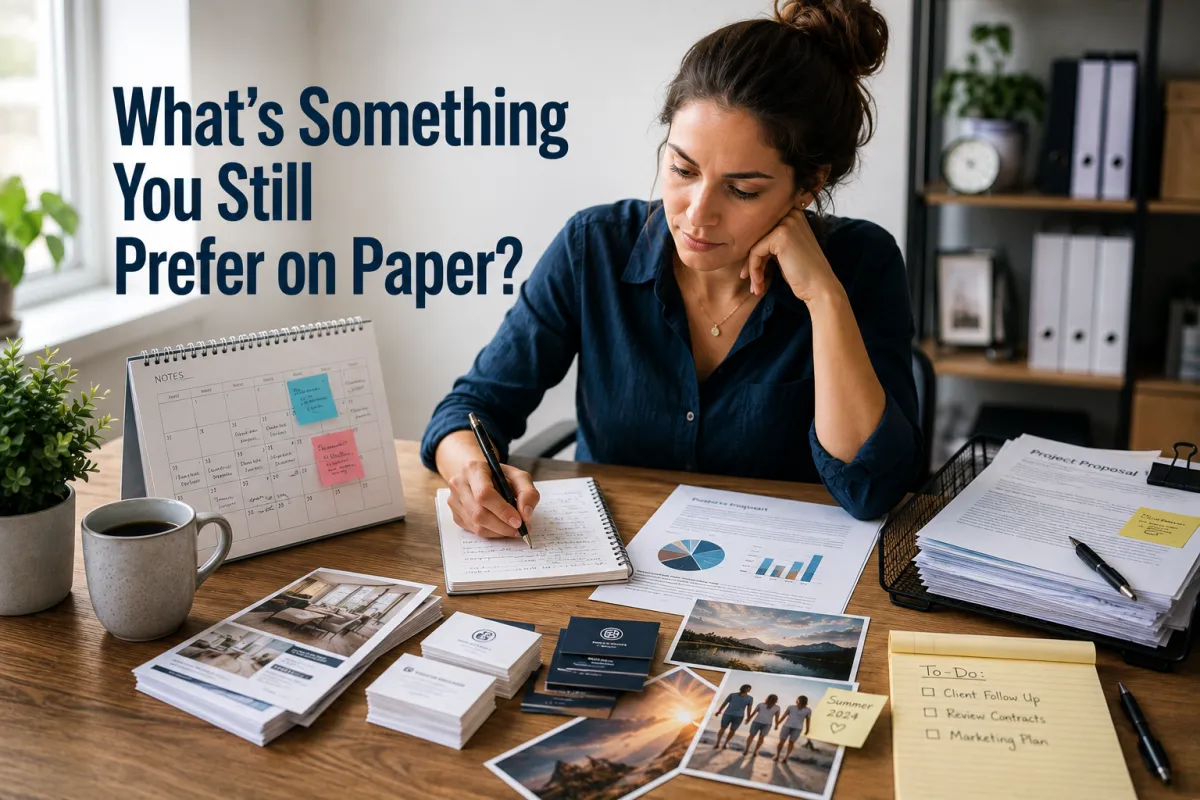
What’s Something You Still Prefer on Paper? Why Print Still Matters in a Digital World
What’s Something You Still Prefer on Paper?
We live in a digital-first world.
We read emails on our phones.
Sign documents electronically.
Store files in the cloud.
Use digital calendars.
Scan QR codes instead of writing down information.
So here's an interesting question:
What's something you still prefer on paper?
Maybe it's a calendar.
A favorite book.
A business card.
Important documents.
A handwritten note.
A printed photograph.
Or perhaps you simply concentrate better when you're looking at a physical page instead of a screen.
The shift toward digital doesn't mean paper has become useless. In many situations, paper still offers practical benefits that digital tools don't completely replace.
Why Do People Still Use Paper?
The answer isn't simply nostalgia.
Paper can serve a practical purpose.
Physical documents can be:
Easy to review
Easy to annotate
Convenient to reference
Visible without opening an app
Useful during meetings
Helpful for organizing information
Easier for some people to read
Available without a device or internet connection
The best format depends on what you're trying to accomplish.
Sometimes digital is better.
Sometimes paper is better.
And sometimes using both is the smartest approach.
1. Paper Can Help You Focus
Have you ever opened your laptop to read one document and ended up checking email five minutes later?
Digital devices are incredibly useful—but they're also full of distractions.
A printed document doesn't send notifications.
It doesn't open another browser tab.
It doesn't tempt you to check social media.
For tasks that require focused reading, reviewing information on paper can create a simpler environment.
This doesn't mean paper is scientifically superior for everyone or every task. Reading preferences vary.
But if you personally concentrate better with printed material, that's a useful reason to keep printing it.
2. Printed Documents Can Be Easier to Annotate
Some people think better when they can physically interact with information.
A printed document allows you to:
Highlight
Circle important sections
Write notes
Add questions
Draw arrows
Mark pages
Rearrange printed pages
For brainstorming or reviewing complicated information, physical interaction can be helpful.
You can always digitize or organize the final version later.
3. Paper Can Make Important Information More Visible
Digital files can disappear into folders.
A document sitting on your desk is harder to forget.
For example:
"Submit this form."
If the form is buried in your downloads folder, you may forget about it.
If it's printed and sitting next to your computer, it becomes a visible reminder.
This can be particularly useful for short-term tasks and documents that require action.
4. Business Cards Still Work
Business networking has become increasingly digital.
You can exchange contact information through your phone, social media, QR codes, and digital business cards.
But physical business cards remain useful.
Why?
Because they're:
Easy to hand over
Simple to store
Convenient at networking events
Useful for referrals
A physical reminder of a conversation
An opportunity to reinforce your brand
A modern business card can also include a QR code that connects the physical card to your digital presence.
Paper doesn't have to compete with digital. It can lead to it.
5. Printed Marketing Materials Can Create a Physical Experience
Businesses have more digital marketing options than ever.
But customers still encounter physical materials every day.
Think about:
Flyers
Brochures
Menus
Postcards
Business cards
Posters
Event invitations
Promotional materials
A physical piece can be picked up, passed to someone else, placed on a counter, or kept for later.
That's different from a social media post that can disappear from someone's feed within minutes.
6. Some People Remember Information Better When They Write It Down
Everyone has different learning and organization preferences.
Some people prefer typing notes.
Others prefer handwriting.
Writing on paper can make information feel more tangible and intentional.
For example, instead of simply adding something to a digital task list, physically writing:
Call client — Tuesday
can create a different kind of visual reminder.
The important thing isn't whether paper is universally better.
It's whether paper works better for you in a particular situation.
7. Printed Photos Feel Different
Digital photos are convenient.
You can take thousands of pictures and carry them all in your pocket.
But physical photographs create something tangible.
A printed photo can:
Go into a frame
Become part of a scrapbook
Be displayed at home
Be given as a gift
Be kept as a physical memory
Digital storage is excellent for preserving large photo libraries.
Printing can make selected memories more meaningful.
Again, the answer doesn't have to be either/or.
Save digitally. Print intentionally.
8. Paper Can Be Useful During Meetings
Not every meeting needs printed materials.
But certain situations benefit from having physical information available.
Examples include:
Presentations
Workshops
Training sessions
Planning meetings
Client consultations
Community events
Printed agendas, handouts, worksheets, or reference materials can give participants something tangible to follow.
The trick is to print what adds value, rather than printing everything automatically.
9. Important Documents May Still Need Physical Copies
Digital storage is extremely useful for organizing information.
But some original documents may still need to be retained.
Depending on your circumstances, this can include certain:
Legal documents
Identification documents
Property records
Certificates
Contracts
Financial records
A digital scan can be an excellent additional copy, but it doesn't automatically replace the original.
Always determine the retention requirements for your particular documents before discarding originals.
10. Paper Can Be Part of a Backup Strategy
Here's an important distinction:
Paper isn't a replacement for digital backup.
Instead, different formats can protect against different problems.
For example:
Original document → Digital scan → Secure digital backup
This approach can make information easier to access if the original is misplaced or damaged.
For documents you're permitted to digitize, scanning can provide an additional layer of organization and accessibility.
Digital vs. Paper: Which Should You Choose?
There's no universal winner.
Consider this simple comparison:
Digital | Paper |
|---|---|
Easy to store in large quantities | Easy to physically reference |
Searchable | Easy to annotate by hand |
Easy to share remotely | Tangible |
Can be accessed across devices | Doesn't require a screen |
Convenient for backups | Useful for visible reminders |
Easy to update | Useful for presentations and handouts |
The smartest option may depend on the task.
Use digital when:
You need searchability, remote access, sharing, or large-scale storage.
Use paper when:
You need physical reference, annotation, visibility, presentation, or a tangible experience.
Use both when:
The information is particularly important.
Don't Print Everything—Print With Purpose
Going paperless doesn't mean never printing anything.
It means being intentional.
Before printing, ask:
Do I need a physical copy?
Will paper make this easier to use?
Do I need to write on it?
Will I need to reference it frequently?
Does the physical format improve the experience?
If the answer is yes, printing may be the right choice.
Paper Can Also Help Create Better Organization
A physical filing system can be useful for documents that require regular reference.
For example, a business might maintain clearly labeled folders for:
Current projects
Financial records
Contracts
Administrative documents
Marketing materials
However, physical filing should work alongside an appropriate digital organization and backup strategy when needed.
The goal isn't to create more paper.
It's to create better organization.
The Environmental Question
It's also reasonable to ask:
"Shouldn't businesses be reducing paper use?"
In many situations, yes.
Unnecessary printing creates waste.
That's why responsible printing means thinking about:
Whether printing is necessary
How many copies are needed
Paper size
Duplex printing
Recycled or appropriate paper options
How long documents need to be retained
Secure disposal when documents are no longer needed
Going digital where it makes sense and printing intentionally can help businesses avoid unnecessary paper use.
When Professional Printing Makes Sense
Printing at home is perfectly suitable for many everyday documents.
But professional printing can be valuable when you need:
Consistent quality
Multiple copies
Specific paper types
Larger formats
Marketing materials
Business cards
Brochures
Flyers
Invitations
Professional presentation
Your printer at home may be great for a quick form.
It may not be the best tool for producing hundreds of polished marketing pieces.
How Ship It - Bay & Beyond Can Help
At Ship It - Bay & Beyond, we help individuals, entrepreneurs, and businesses manage the physical side of their everyday information and business needs.
Printing & Copying
Print business cards, flyers, brochures, documents, invitations, forms, and other materials.
Document Scanning
Create digital copies of eligible paperwork for easier organization and backup.
Secure Document Shredding
Once you've confirmed that documents no longer need to be retained, securely dispose of confidential paper records.
Packing & Shipping
Prepare and ship documents, packages, products, and other items.
Private Mailboxes
Dedicated mailing solutions for personal or business correspondence and eligible packages, subject to applicable requirements.
Virtual Mailboxes
Flexible mail-management options for people who aren't always in one location, depending on available service features.
Package Receiving
Convenient receiving options for eligible packages.
Notary Services
Notary services for eligible personal and business documents.
Fingerprinting
Fingerprinting services for eligible employment, licensing, and other requirements.
Passport Photos
Professional passport photo services for eligible applications.
Proudly Serving the Tampa Bay Area
Ship It! Bay & Beyond proudly serves individuals, families, entrepreneurs, and businesses throughout the Tampa Bay region, including:
St. Petersburg
Tampa
Clearwater
Largo
Pinellas Park
Seminole
Gulfport
Kenneth City
Treasure Island
St. Pete Beach
Madeira Beach
Indian Rocks Beach
Indian Shores
Redington Beach
North Redington Beach
Redington Shores
Safety Harbor
Oldsmar
Dunedin
Palm Harbor
Tarpon Springs
Belleair
Belleair Bluffs
Lealman
Pinellas County
Hillsborough County
And surrounding communities.
Whether you need professional packing and shipping, printing, private mailbox services, virtual mailbox services, package receiving, notary services, fingerprinting, secure shredding, document scanning, copying, passport photos, business formation, or office services, Ship It! Bay & Beyond is your trusted local partner.
The Bottom Line
Digital technology has changed the way we communicate, work, and organize information.
But paper hasn't disappeared.
And it doesn't necessarily need to.
A printed document can be easier to annotate.
A business card can make a networking connection tangible.
A flyer can reach someone offline.
A printed photograph can become a physical memory.
A paper checklist can sit where you can actually see it.
The key isn't choosing paper over digital.
It's understanding when each format works best.
Use technology when it makes life easier.
Use paper when it adds something technology can't.
And when you need both?
There's nothing wrong with that.
Frequently Asked Questions
Is paper still useful in a digital world?
Yes. Paper can be useful for physical reference, annotation, presentations, business materials, visible reminders, and situations where a tangible format is more convenient.
Are printed business cards still relevant?
Yes. Business cards can still be useful for face-to-face networking, referrals, local business relationships, and branding. They can also connect physical networking with digital platforms through QR codes.
Should I keep physical copies of important documents?
It depends on the document. Some originals may have legal, financial, identification, or other significance and should be retained. Determine the appropriate retention requirements before discarding any original.
Is scanning documents better than keeping paper copies?
Scanning can make documents easier to organize, access, and back up, but it doesn't automatically replace the original. For important records, consider whether both physical and digital copies should be maintained.
When is professional printing worth it?
Professional printing can be particularly useful for business cards, marketing materials, invitations, brochures, flyers, and other materials where print quality and presentation matter.
How can businesses reduce unnecessary paper use?
Use digital files when they provide a clear advantage, print only what is needed, consider double-sided printing, organize documents efficiently, and securely dispose of confidential paperwork when it no longer needs to be retained.
