What to Expect at Your Fingerprinting Appointment: A Simple Guide
What to Expect at Your Fingerprinting Appointment
Introduction
If you've never had your fingerprints taken for an employment application, professional license, background check, volunteer position, or other official requirement, you may not know exactly what to expect.
Is it complicated?
Does it hurt?
What should you bring?
How long does it take?
What happens to your fingerprints afterward?
The good news is that a fingerprinting appointment is generally straightforward.
The most important thing is to understand why you're being fingerprinted and what the requesting organization requires before you arrive.
A little preparation can make your fingerprinting appointment much easier.
Why Do People Need to Be Fingerprinted?
Fingerprinting is commonly used as part of identity verification and background-check processes.
Depending on the organization and purpose, fingerprinting may be required for:
Employment
Professional licensing
Occupational licensing
Volunteer positions
Education-related requirements
Government applications
Regulatory requirements
Background checks
Certain certifications
The exact requirements depend on the organization requesting the fingerprints.
That's why it's important to follow the instructions provided by the employer, licensing agency, government organization, or other requesting entity.
What Is Live Scan Fingerprinting?
You may hear the term Live Scan when scheduling a fingerprinting appointment.
Live Scan generally refers to electronic fingerprint capture.
Instead of applying ink to your fingers and placing them on a physical fingerprint card, an electronic scanner captures your fingerprints digitally.
The process is designed to collect your fingerprints for submission through the appropriate system.
However, not every organization uses the same submission process.
Some may require specific forms, codes, agencies, or submission instructions.
Don't assume that any fingerprinting service can be used for every application.
Check the requirements before booking.
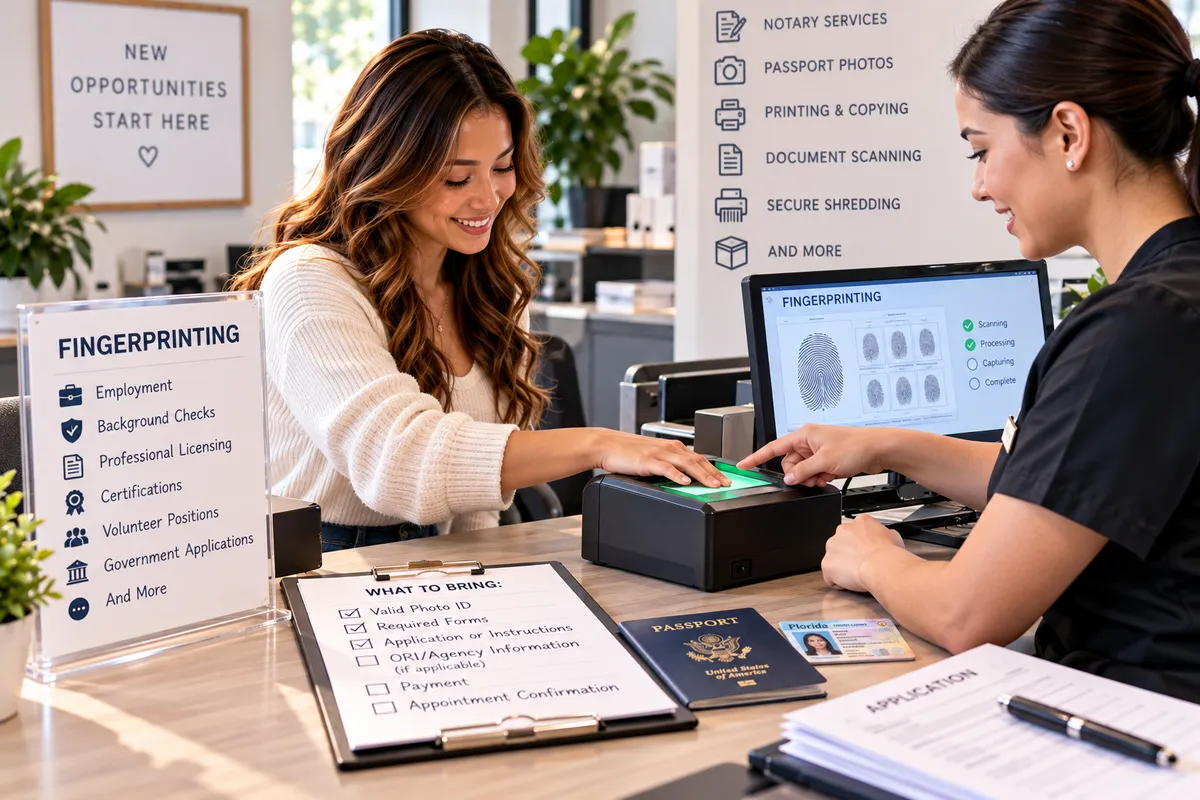
What Should You Bring?
Before your appointment, review the instructions from the organization requesting your fingerprints.
You may need to bring:
Government-issued photo identification
Fingerprinting authorization or application documents
ORI or agency information, when applicable
Appointment confirmation
Payment
Any required forms
The exact requirements can vary.
Your identification should match the information used for the fingerprinting request.
If you're unsure what identification or paperwork is required, contact the requesting organization or fingerprinting provider before your appointment.
What Kind of Identification May Be Required?
Fingerprinting providers typically need to verify who you are before collecting your fingerprints.
Depending on the requirements, acceptable identification may include a government-issued photo ID.
Examples can include:
Driver's license
State-issued identification
Passport
Other qualifying government identification
Requirements vary by provider and requesting agency.
Don't rely on an assumption about which ID will be accepted.
Check the specific instructions before your appointment.
What Happens When You Arrive?
Your appointment may begin with an identification and paperwork check.
The provider may verify:
Your name
Identification
Date of birth
Application information
Agency or submission details
Required forms
This information helps ensure your fingerprints are associated with the correct request.
If something doesn't match, it may need to be corrected before the submission can proceed.
How Are Your Fingerprints Taken?
For electronic fingerprinting, you'll generally place your fingers on a fingerprint scanner as instructed.
The technician may capture:
Individual fingers
Rolled impressions
Flat impressions
Other required fingerprint information
You may be asked to reposition your hands or fingers during the process.
The technician will guide you through it.
You don't need to know how to position your fingers beforehand.
Just follow the technician's instructions.
Does Fingerprinting Hurt?
For most people, fingerprint collection is not painful.
There are no needles involved in standard electronic fingerprint capture.
The process generally involves placing your fingers against a scanner.
If your hands are unusually dry, wet, dirty, or affected by certain conditions, obtaining clear prints may sometimes be more difficult.
The technician may provide instructions to help improve the quality of the fingerprint capture.
What If Your Fingerprints Don't Scan Clearly?
Don't panic.
Fingerprint quality can vary.
Factors such as:
Dry skin
Excess moisture
Dirt or residue
Minor skin damage
Certain occupations
Age
Natural fingerprint characteristics
can sometimes affect the quality of a scan.
A trained technician can usually determine whether another attempt is needed.
If the requesting agency has specific procedures for prints that cannot be captured successfully, those instructions will determine what happens next.
How Long Does a Fingerprinting Appointment Take?
The actual fingerprint capture may be relatively quick.
However, the total appointment time can vary depending on:
Required paperwork
Identification verification
Fingerprint quality
Submission requirements
Whether additional information is needed
If you're going to an appointment before work, an interview, or another scheduled event, allow some extra time rather than planning to arrive at the exact minute you need to leave.
What Happens to Your Fingerprints After the Appointment?
This depends on the purpose of the fingerprinting.
Your fingerprints may be submitted through a designated system to the appropriate agency or organization for processing.
The fingerprinting provider generally handles the collection and submission according to the applicable instructions.
The provider may not be the organization conducting the actual background check.
Fingerprint collection and background-check processing are not necessarily the same step.
If you're waiting for results, the requesting organization may be the best source for questions about processing times or status.
Will You Get Your Results Immediately?
Usually, you shouldn't assume that fingerprinting means immediate background-check results.
The fingerprinting appointment is often simply the collection and submission stage.
Processing time can depend on:
The requesting agency
Background-check system
Type of application
Volume of submissions
Additional review requirements
If you need results by a specific deadline, schedule your fingerprinting early enough to allow for processing.
What If Your Employer Gave You a Fingerprinting Form?
Bring it with you.
Some fingerprinting requests contain information that the technician needs to process your fingerprints correctly.
This could include specific agency information or other identifiers.
Don't leave required forms at home.
A missing form or incorrect information can potentially delay the process.
Can You Just Walk In?
Some fingerprinting providers accept walk-ins.
Others operate by appointment.
Availability can also depend on the type of fingerprinting service you need.
If you have a deadline, scheduling an appointment ahead of time can help reduce uncertainty.
Before arriving, confirm:
Location
Hours
Appointment requirements
Accepted identification
Required forms
Payment methods
Type of fingerprinting offered
What Should You Do Before Your Appointment?
A few simple preparations can help.
1. Read the Instructions
Know exactly why you are being fingerprinted and who is requesting it.
2. Confirm the Fingerprinting Type
Determine whether you need electronic fingerprinting, ink fingerprinting, or a specific fingerprint card.
3. Gather Your ID
Make sure you have an acceptable government-issued identification document.
4. Bring Required Forms
Don't assume the provider already has everything.
5. Confirm the Submission Details
Some applications have specific agency or program requirements.
6. Arrive Prepared
Clean hands and reasonable skin condition can help make the process smoother.
What If You Have Cuts or Injuries on Your Fingers?
If you have a temporary injury that affects your fingerprints, tell the technician.
Depending on the circumstances and the requirements of the requesting agency, the technician may be able to advise you about the next step.
If the fingerprints cannot be captured successfully, the requesting organization may have additional procedures.
Don't simply assume the appointment should be canceled.
Ask first.
What If Your Fingerprints Have Changed?
Fingerprint patterns are generally highly distinctive, but the quality of captured impressions can be affected by various factors.
People who work with their hands may experience changes to the surface of their fingertips.
For example:
Construction workers
Mechanics
Landscapers
Artists
Healthcare workers
Food-service workers
may experience wear or irritation that affects fingerprint capture.
If this applies to you, mention it to the technician.
Fingerprinting Is Only One Part of the Process
It's easy to think:
"I got fingerprinted, so I'm finished."
Not necessarily.
Your overall application may still require:
Forms
Identification
Fees
Background processing
Documentation
Training
Licensing
Employer review
Fingerprinting is often one component of a larger process.
Complete the fingerprinting correctly—but don't forget the rest of the checklist.
Keep Your Confirmation and Records
After your appointment, keep any documentation you're given.
Depending on the service, you may receive information such as:
Receipt
Transaction confirmation
Submission information
Appointment record
Store it with your other application documents.
If your application experiences a delay, having your records available can make it easier to provide relevant information to the requesting organization.
Common Fingerprinting Mistakes to Avoid
Showing Up Without Proper Identification
Always confirm what ID is accepted.
Forgetting Required Forms
Bring any paperwork supplied by the requesting agency.
Going to the Wrong Type of Provider
Not every fingerprinting service handles every type of submission.
Waiting Until the Deadline
Processing may take longer than expected.
Assuming the Provider Controls the Background Check
The fingerprinting provider may only collect and submit your fingerprints.
Giving Incorrect Information
Review your forms carefully before submission.
Fingerprinting for a New Career
Fingerprinting can be one of those tasks that appears unexpectedly when starting a new career.
You may already have:
Updated your resume
Completed an interview
Accepted an offer
Then you're told:
"You need to complete fingerprinting."
If you're prepared, it's simply another item on the checklist.
If you're not, it can become an unnecessary delay.
That's why understanding the process before your appointment matters.
Fingerprinting for Professional Licensing
Many professions have specific licensing or regulatory requirements.
If fingerprinting is part of your application, carefully follow the instructions provided by the relevant licensing organization.
Don't rely solely on general online information.
The requesting agency's instructions should be your primary guide.
Requirements can change, and different professions may use different procedures.
How Ship It - Bay & Beyond Can Help
At Ship It - Bay & Beyond, we provide fingerprinting services for individuals who need professional fingerprint collection for employment, licensing, background-check, and other qualifying purposes.
We also offer:
Notary services
Passport photos
Printing
Copying
Document scanning
Secure document shredding
Private mailboxes
Virtual mailbox services
Package receiving
Professional packing and shipping
Business formation support
U-Haul
Moving supplies
Office services
Need to prepare several documents for the same application?
Having access to printing, copying, scanning, passport photos, notary, and fingerprinting services in one location can make the process more convenient.
One appointment can be one less thing to worry about.
Proudly Serving the Tampa Bay Area
Ship It - Bay & Beyond proudly serves:
St. Petersburg
Tampa
Clearwater
Largo
Pinellas Park
Seminole
Gulfport
Kenneth City
Treasure Island
St. Pete Beach
Madeira Beach
Indian Rocks Beach
Indian Shores
Redington Beach
North Redington Beach
Redington Shores
Safety Harbor
Oldsmar
Dunedin
Palm Harbor
Tarpon Springs
Belleair
Belleair Bluffs
Lealman
Pinellas County
Hillsborough County
Surrounding communities
Whether you need professional packing & shipping, printing, a private or virtual mailbox, notary, fingerprinting, secure shredding, document scanning, copying, passport photos, business formation, U-Haul, moving supplies, or other office services, Ship It - Bay & Beyond is your trusted local partner.
The Bottom Line
A fingerprinting appointment doesn't have to be intimidating.
For most people, the process is straightforward:
Bring the right identification → Bring the required paperwork → Verify your information → Have your fingerprints captured → Confirm the submission → Keep your records.
The most important step happens before you arrive:
Know exactly what the requesting organization requires.
That can help prevent delays and make your appointment much smoother.
