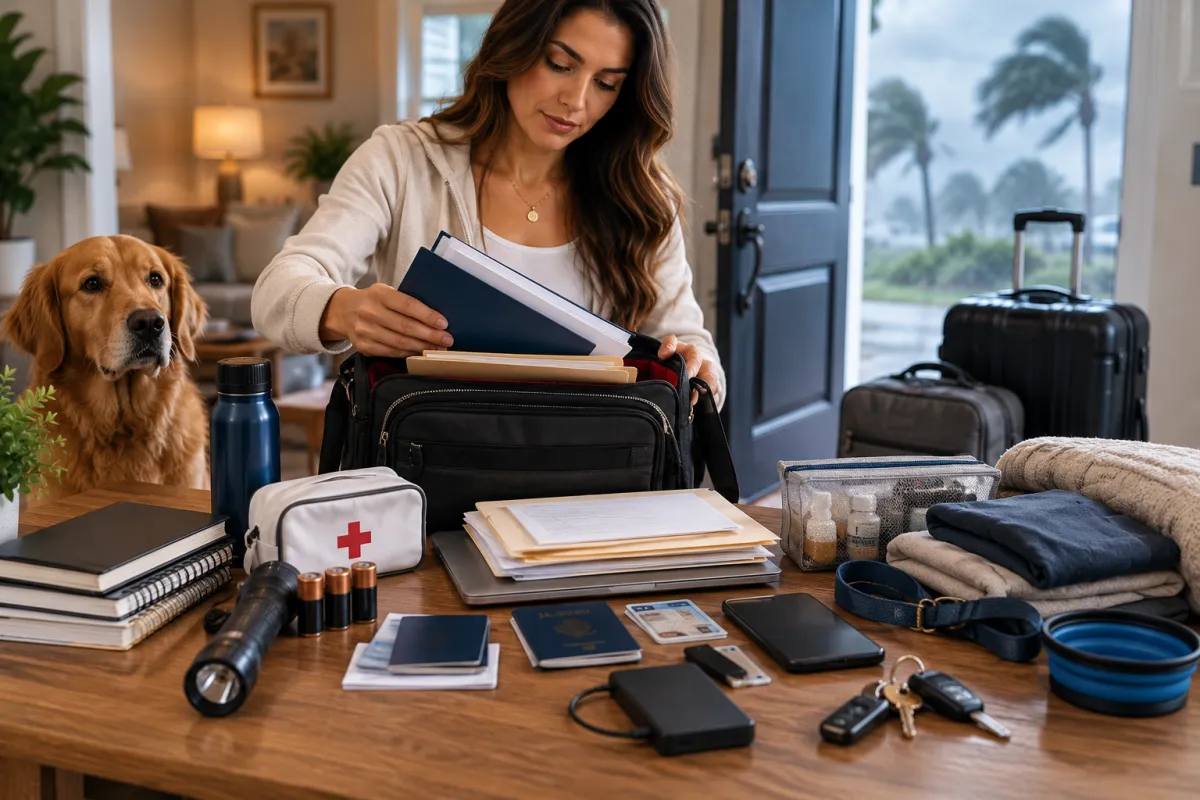
What Would You Grab First If Your Home Had to Be Evacuated? Emergency Document Checklist
What Would You Grab First If Your Home Had to Be Evacuated?
Imagine getting an alert that says:
EVACUATE NOW.
You have minutes—not hours—to decide what you're taking with you.
You grab your phone.
Your wallet.
Your keys.
Your family.
Your pets.
Then you look around your home and suddenly realize:
How do you decide what else matters?
Important documents are scattered across drawers. Family records are in a filing cabinet. Insurance information is somewhere on your computer. You have paperwork you haven't looked at in years.
In an emergency, you don't want to spend valuable time trying to remember where everything is.
That's why emergency preparedness isn't only about having food, water, and flashlights.
It's also about knowing where your most important information is—and making sure you can access it when you need it.
Why Emergency Document Planning Matters
Natural disasters and other emergencies can happen with little warning.
Depending on where you live, you may need to prepare for situations involving:
Severe storms
Flooding
Wildfires
Hurricanes
Tornadoes
Extended power outages
Evacuation orders
Other emergencies
Your physical possessions can be difficult to replace.
But certain documents can be particularly challenging because they may be needed to prove:
Identity
Ownership
Insurance coverage
Financial information
Business status
Legal relationships
Important personal records
Having a plan for those documents before an emergency can reduce unnecessary stress.
First Rule: Don't Put Yourself at Risk for Your Belongings
This is the most important part of any evacuation plan.
People and pets come first.
If authorities issue an evacuation order, follow official instructions.
Don't delay leaving because you're trying to collect paperwork or valuables.
Emergency preparation should happen before an evacuation—not while you're trying to get out the door.
The goal is to have important information organized and accessible so you don't have to spend precious time searching for it.
1. What Documents Would You Want Access To?
Everyone's needs are different, but consider creating an emergency document list.
Important records may include:
Personal Identification
Government-issued identification
Passports
Birth certificates
Social Security-related records
Citizenship or immigration documents, when applicable
Financial
Bank information
Insurance policies
Important account information
Property records
Loan information
Legal
Wills
Powers of attorney
Trust documents
Legal agreements
Other important legal records
Household
Mortgage or lease information
Home insurance
Vehicle documents
Property records
Warranty information
Medical
Health insurance information
Prescription information
Important medical records
Emergency contacts
Business
If you own a business, consider:
Business registration documents
Licenses
Insurance records
Contracts
Financial records
Important client or vendor information
You don't necessarily need to carry every document with you.
The important part is knowing which records matter and how you would access them if your home became unavailable.
2. Create an Emergency Document Folder
One simple strategy is creating a dedicated emergency document collection.
This could be physical, digital, or both.
For physical records, use a secure and appropriately protected location.
For digital records, organize important files into a clearly labeled folder.
For example:
Emergency Documents
→ Identification
→ Insurance
→ Financial
→ Legal
→ Property
→ Medical
→ Business
The goal is simple:
Don't make yourself search through hundreds of unrelated files during an emergency.
3. Make Digital Copies of Eligible Documents
One of the easiest ways to improve document preparedness is to digitize important paperwork you're permitted to scan and store electronically.
A scanner can turn a physical document into a digital file that can be organized and backed up.
A simple process is:
Paper → Scan → Organize → Back Up → Secure
This can be particularly helpful for documents you may need to reference but don't necessarily need to carry with you.
However, remember:
A digital copy doesn't automatically replace the original.
Some original documents may need to be retained.
Before discarding an original, determine whether it has legal, financial, identification, or other significance.
4. Don't Store Your Only Copy at Home
This is an important part of emergency planning.
Imagine your home is damaged and your important documents are inside.
If the only copies are physically stored there, accessing them may become difficult.
That's why having appropriately secured copies in another location can be valuable.
Depending on the document and your circumstances, this might include:
Secure cloud storage
A separate physical location
An appropriate backup device
Another trusted storage solution
The goal is to avoid having one point of failure.
5. Back Up Your Digital Records Too
Digitizing your documents is only the first step.
You also need to think about what happens if your computer fails.
Important digital records shouldn't exist in only one place.
Consider maintaining appropriate backups and protecting them with:
Strong passwords
Multi-factor authentication
Access controls
Encryption where appropriate
Regular backup procedures
A backup should also be tested periodically to make sure files can actually be recovered.
6. Insurance Information Deserves Special Attention
After a disaster, insurance information can become extremely important.
You may need access to:
Policy numbers
Insurance company contact information
Coverage details
Claims information
Property documentation
Consider maintaining accessible copies of relevant insurance records.
You may also want to keep documentation that helps establish what you own, such as appropriate:
Receipts
Photos
Videos
Serial numbers
Appraisals
A home inventory can make it easier to document possessions when appropriate.
7. Make a Home Inventory
You don't need to photograph every spoon in your kitchen.
Start with significant possessions.
Consider documenting:
Electronics
Jewelry
Furniture
Appliances
Collectibles
Business equipment
Tools
Valuable personal property
Take photographs or video and organize the information.
For higher-value items, keep receipts, appraisals, or other supporting documentation when available.
Store the inventory securely and, ideally, somewhere other than only on the device located inside your home.
8. Business Owners Have Another Layer to Consider
If you operate a business from home, an evacuation can affect more than your personal life.
You may also need to think about:
Customer information
Business records
Contracts
Financial documents
Tax records
Licenses
Insurance
Inventory
Equipment
This is another reason businesses should have a continuity plan.
Ask:
"If I couldn't enter my office or home tomorrow, could my business still access its critical information?"
If the answer is no, that's a vulnerability worth addressing.
9. Know What You Actually Need to Take
An emergency isn't the time to carry an entire filing cabinet.
Create a short list of the items that would be most difficult to replace or access.
Your emergency document kit might include appropriately protected copies of:
Identification
Insurance information
Essential financial information
Important legal documents
Medical information
Emergency contacts
Business-critical information
Keep the list specific to your household.
10. Consider a Physical Emergency Document Kit
For documents that genuinely need to be physically accessible, consider keeping an organized emergency folder or kit.
Depending on your circumstances, you may use:
A waterproof document pouch
A fire-resistant storage solution
A portable document organizer
The exact protection you need depends on the risks in your area and the importance of the records.
The key is making important documents easy to locate and appropriately protected.
11. Don't Forget Your Emergency Contacts
During stressful situations, even simple information can become difficult to remember.
Maintain an accessible list of:
Family members
Close friends
Doctors
Insurance providers
Financial institutions
Emergency contacts
Important business contacts
Include phone numbers and other relevant information.
Don't assume you'll always have access to your normal contact list.
12. Review Your Documents Before an Emergency Happens
Emergency preparedness isn't a one-time task.
Your information changes.
You may:
Move
Change insurance providers
Open a new account
Start a business
Change your phone number
Get a new vehicle
Update legal documents
Set a reminder to review your emergency records periodically.
An outdated emergency file can be almost as frustrating as having no file at all.
13. Don't Forget Your Mail
Mail can contain sensitive and important information.
Think about what may arrive at your home:
Bank correspondence
Insurance notices
Government correspondence
Business documents
Bills
Legal notices
If you're away from home because of an emergency or extended evacuation, having a reliable mail-management plan can help prevent important correspondence from being overlooked.
This is particularly useful for people who travel frequently or have a second residence.
14. Packages Need a Plan Too
Emergencies can disrupt deliveries.
If you're away from home, packages may continue arriving.
Depending on the carrier and circumstances, deliveries may be:
Attempted
Held
Redirected
Returned
Left according to delivery instructions
If you're expecting an important shipment, monitor tracking information and make appropriate arrangements.
Having a package receiving option can also provide an alternative for eligible deliveries when you're not available at your usual location.
15. What About Confidential Documents?
Emergency preparation can reveal just how much sensitive information you have sitting around.
Old paperwork may contain:
Account numbers
Addresses
Financial information
Personal information
Customer information
Business information
Once you've confirmed that a document no longer needs to be retained, don't simply toss it in the trash.
Securely dispose of confidential paperwork.
This helps reduce the amount of sensitive information sitting around your home or office.
16. Your Emergency Plan Should Include Your Digital Life
Your phone may be one of the most valuable tools you have during an emergency.
But what happens if it gets lost or damaged?
Consider making sure you have secure access to:
Important contacts
Insurance information
Emergency documents
Digital backups
Account recovery methods
Don't make your entire emergency plan dependent on one device.
A Simple Emergency Document Checklist
Create your own checklist and keep it updated.
Identification
☐ IDs
☐ Passports
☐ Birth certificates
☐ Other important identity documents
Home & Property
☐ Insurance information
☐ Lease or mortgage documents
☐ Property records
☐ Home inventory
Financial
☐ Important financial records
☐ Account information
☐ Tax-related documents
Legal
☐ Wills
☐ Powers of attorney
☐ Important agreements
☐ Other critical legal documents
Medical
☐ Health insurance information
☐ Prescription information
☐ Important medical records
☐ Emergency contacts
Business
☐ Licenses
☐ Registrations
☐ Contracts
☐ Insurance
☐ Critical financial records
Digital
☐ Scan eligible documents
☐ Organize files
☐ Back up important information
☐ Test recovery
☐ Protect account access
A 15-Minute Emergency Preparedness Exercise
You don't have to organize your entire house today.
Set a timer for 15 minutes.
Minute 1–5: Identify
Write down the documents you'd be most worried about losing.
Minute 6–10: Locate
Find where those documents currently are.
Minute 11–15: Plan
Decide:
Keep physical?
Scan?
Back up?
Store elsewhere?
Securely dispose of old copies?
You don't have to complete everything immediately.
The goal is to identify the gaps.
The Most Important Thing to Grab May Not Be an Object
During an emergency, we naturally think about possessions.
But information can be just as important.
A document may help you:
File an insurance claim
Prove ownership
Access an account
Verify identity
Contact a provider
Rebuild business operations
Replace something that was lost
That's why document preparedness deserves a place in your emergency plan.
How Ship It - Bay & Beyond Can Help
At Ship It - Bay & Beyond, we help individuals, families, entrepreneurs, and businesses organize, digitize, manage, and securely handle important documents.
Document Scanning
Digitize eligible paperwork so important information can be organized and backed up more easily.
Printing & Copying
Create physical copies of important documents, checklists, forms, and emergency information.
Secure Document Shredding
Once you've confirmed that documents no longer need to be retained, securely dispose of confidential paperwork.
Private Mailboxes
Dedicated mailing solutions for personal or business correspondence and eligible packages, subject to applicable requirements.
Virtual Mailboxes
Flexible mail-management options for people who aren't always in one location, depending on available service features.
Package Receiving
Convenient receiving options for eligible packages.
Packing & Shipping
Professional packing and shipping assistance for important personal and business shipments.
Notary Services
Notary services for eligible personal and business documents.
Fingerprinting
Fingerprinting services for eligible employment, licensing, and other requirements.
Passport Photos
Professional passport photo services for eligible applications.
Proudly Serving the Tampa Bay Area
Ship It - Bay & Beyond proudly serves individuals, families, entrepreneurs, and businesses throughout the Tampa Bay region, including:
St. Petersburg
Tampa
Clearwater
Largo
Pinellas Park
Seminole
Gulfport
Kenneth City
Treasure Island
St. Pete Beach
Madeira Beach
Indian Rocks Beach
Indian Shores
Redington Beach
North Redington Beach
Redington Shores
Safety Harbor
Oldsmar
Dunedin
Palm Harbor
Tarpon Springs
Belleair
Belleair Bluffs
Lealman
Pinellas County
Hillsborough County
Surrounding communities
Whether you need professional packing and shipping, printing, private mailbox services, virtual mailbox services, package receiving, notary services, fingerprinting, secure shredding, document scanning, copying, passport photos, business formation, or office services, Ship It! Bay & Beyond is your trusted local partner.
The Bottom Line
If you had to evacuate your home tomorrow, you probably wouldn't have time to search through every drawer, closet, and filing cabinet.
That's why emergency document preparation matters.
You don't need to take everything.
You need to know what matters most, where it is, and how you would access it if your home became unavailable.
Start with the essentials.
Identify important records.
Scan eligible documents.
Create secure backups.
Protect important originals.
Keep insurance information accessible.
Maintain an updated home inventory.
Securely dispose of unnecessary confidential paperwork.
And most importantly:
Never delay an evacuation to save belongings.
Your emergency plan should make leaving easier—not give you another reason to hesitate.
Because when an emergency happens, the question shouldn't be:
"Where did I put that document?"
It should be:
"I already have a plan."
Frequently Asked Questions
What documents should I keep in an emergency kit?
Consider important identification, insurance information, essential financial and legal records, medical information, emergency contacts, and critical business documents. Your exact list should reflect your household and circumstances.
Should I scan my important documents?
For documents you're permitted to digitize, scanning can create accessible digital copies and make backups easier. However, scanning does not automatically mean the original can be discarded.
Where should I store digital copies of important documents?
Use an appropriately secured storage and backup system. Consider access controls, strong authentication, encryption where appropriate, and maintaining copies that aren't dependent on a single device.
Should I keep paper copies of important documents?
Some originals may need to be retained, depending on the document. Keep important originals appropriately protected and determine whether additional physical copies are useful for your circumstances.
What should I do with old documents before an emergency?
Review them according to applicable retention requirements. Keep what you need, digitize eligible records when useful, and securely shred confidential documents that you have confirmed no longer need to be retained.
Should I evacuate with all my important documents?
Your evacuation plan should prioritize people and pets and follow official emergency instructions. Rather than delaying evacuation to collect paperwork, prepare important information in advance so it is appropriately protected and accessible.
