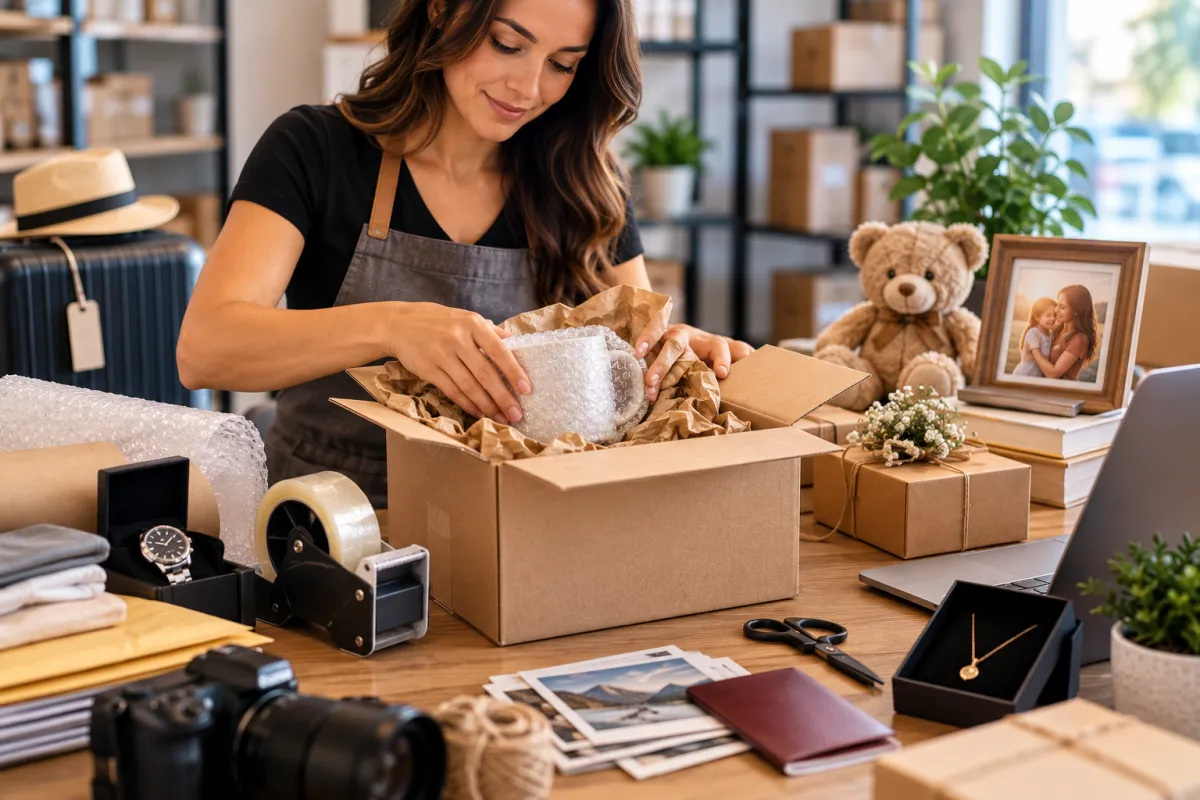
When a Package Is More Than Just a Package: Why Proper Packing and Shipping Matter
When a Package Is More Than Just a Package
A box can look like just a box.
Until you realize what's inside.
It could contain a customer's first order.
A family keepsake.
A handmade product from a small business.
Important documents.
A gift from someone you love.
A replacement part your customer urgently needs.
Or something that took months to create.
That's when a package becomes more than just a package.
It's not simply cardboard, tape, and a shipping label.
It's someone's time, money, effort, memories, or expectations packed inside.
And that's why how you prepare a package matters.
What's Really Inside the Box?
When people think about shipping, they often focus on the physical item.
But the actual value of a shipment can include much more.
Emotional Value
A package might contain:
Family photographs
Handmade gifts
Personal keepsakes
Sentimental belongings
Items connected to important memories
An item doesn't have to be expensive to be irreplaceable.
Financial Value
For a business, a package could represent:
A customer order
Inventory
Equipment
Merchandise
A replacement item
A completed project
If it arrives damaged, the financial consequences can extend beyond the item itself.
Time Value
Sometimes the most valuable thing inside a box is time.
A shipment might be needed for:
An event
A business deadline
A repair
A customer appointment
A project
A special occasion
A delay can create problems even when the item eventually arrives safely.
1. Packaging Is the First Layer of Protection
A shipping box isn't automatically protective.
The packaging needs to match what's inside.
Consider:
Size
Weight
Shape
Fragility
Movement
Moisture exposure
Handling conditions
Distance traveled
A delicate item placed inside an oversized box with little cushioning may have much more room to move during transportation.
That movement can increase the risk of damage.
The goal isn't simply to put something in a box.
It's to create an appropriate protective system around it.
2. Empty Space Can Become a Problem
One of the most common packaging mistakes is leaving too much empty space.
If an item can move freely inside the box, it may experience additional impacts during handling.
Proper cushioning can help limit movement.
Depending on the item, packaging materials may include:
Bubble cushioning
Packing paper
Foam
Air-filled cushioning
Corner protection
Dividers
Inserts
The right material depends on what you're shipping.
More cushioning isn't automatically better.
The packaging should be appropriate for the item.
3. Too Much Pressure Can Also Cause Damage
Here's the opposite problem.
People sometimes assume that if an item is packed extremely tightly, it must be safer.
Not always.
Certain products can be damaged by excessive pressure or by packaging materials that don't accommodate their shape.
For fragile items, the objective is controlled protection—not simply filling every inch of space.
4. The Box Matters
Not every box is appropriate for every shipment.
A box should be suitable for:
The item's weight
Dimensions
Fragility
Number of items
Handling requirements
A damaged, weakened, or unsuitable box may not provide the protection you expect.
When reusing a box, inspect it carefully.
Look for:
Crushed corners
Tears
Punctures
Water damage
Weak seams
Excessive wear
If the box has already lost structural strength, replacing it may be the better choice.
5. Heavy Items Need Special Attention
Weight changes how a package behaves.
Heavy items can place additional stress on:
Box seams
Bottom panels
Tape
Internal cushioning
For heavier shipments, consider:
A strong box appropriate for the weight
Reinforced seams
Adequate internal cushioning
Proper weight distribution
Don't rely on a small strip of ordinary tape to hold a heavy shipment together.
6. Fragile Items Need More Than a "FRAGILE" Sticker
A fragile label can communicate that a package requires care.
But the label isn't a substitute for good packaging.
If something is breakable, the primary protection should come from:
Appropriate box + cushioning + immobilization + secure closure
A sticker can provide information.
Packaging provides physical protection.
7. The H-Taping Method Is Simple but Important
For many standard boxes, an H-taping pattern can help secure the major seams.
The basic idea is to tape:
Along the center seam
Across the ends of the seam
This creates an "H" pattern.
For heavier or higher-risk packages, additional reinforcement may be appropriate.
The exact packaging method should depend on the box and shipment.
8. Don't Forget What's Happening Inside
A package can look perfect from the outside and still be poorly packed.
Before sealing a box, ask:
Can the item move?
If yes, consider additional cushioning or stabilization.
Can one item hit another?
If yes, separate them appropriately.
Are fragile surfaces protected?
Consider appropriate padding or protective materials.
Is the item protected from the box walls?
If needed, create sufficient cushioning around vulnerable areas.
Is the weight distributed appropriately?
Avoid unnecessary imbalance.
9. Shipping Labels Matter
A well-packed package can still experience problems if the shipping information is incorrect or difficult to read.
Before handing over your package, verify:
Recipient name
Delivery address
Return address
Service level
Special instructions, where applicable
Tracking information
Remove or cover old labels and barcodes if you're reusing a box.
You don't want outdated shipping information confusing the current shipment.
10. Protect Your Personal Information
Shipping labels can contain personal or business information.
Depending on the label, this may include:
Name
Address
Business name
Tracking information
Think about what happens to the box after delivery.
Someone may see the exterior before it reaches the recipient.
After receiving a package, remove or securely obscure identifying labels before recycling or reusing the box.
Good shipping habits can also be good privacy habits.
11. Tracking Helps You Stay Informed
A tracking number can provide useful visibility into a shipment's progress.
It may help you determine:
Whether the package was accepted
Whether it's moving through the carrier network
Whether there's a delivery attempt
Whether it's been delivered
But tracking information isn't always updated continuously.
A temporary gap doesn't necessarily mean the package is lost.
If tracking appears stalled, review the carrier's information and consider contacting the carrier or shipping provider when appropriate.
12. Timing Can Matter as Much as Packaging
Imagine you've carefully packed a product.
But you wait until the last possible moment to ship it.
Now the shipment has very little room for unexpected delays.
Planning ahead gives you more options.
It can help account for:
Weekends
Holidays
Weather
Carrier delays
Address issues
Delivery attempts
Unexpected disruptions
The earlier you plan, the more flexibility you have.
13. Businesses Have More at Stake
For a business, shipping is part of the customer experience.
A customer may judge the company based on:
How quickly it arrived.
Whether it arrived intact.
How professionally it was packaged.
Whether the shipment information was accurate.
That means packaging isn't simply an operational task.
It's part of your brand.
A carefully prepared shipment can communicate attention to detail before the customer even opens the box.
14. Packaging Can Protect Your Reputation
Imagine ordering a handmade product online.
The item arrives damaged.
Even if the carrier caused the damage, the customer may remember the experience as a problem with the business.
Poor packaging can create:
Returns
Replacements
Refunds
Customer complaints
Negative reviews
Lost time
Professional packaging can help reduce avoidable problems.
15. Some Packages Carry Emotional Weight
Not everything important can be measured in dollars.
Consider mailing:
A family heirloom
A child's artwork
Wedding items
Old photographs
A handmade gift
A personal keepsake
If something is sentimental, the question isn't simply:
"How much is it worth?"
It's:
"What would it mean if I couldn't replace it?"
That answer should influence how carefully you prepare it.
16. Know When to Ask for Professional Help
Some shipments are straightforward.
Others are not.
Consider getting professional packing assistance when:
The item is fragile
The item is unusually shaped
The package is heavy
The contents are valuable
You're shipping multiple delicate items
You're unsure what packaging to use
The shipment is particularly important
You don't have to become a packaging expert just to send one important item.
Sometimes the smartest option is asking someone who does this every day.
A Simple Pre-Shipping Checklist
Before handing over your package, ask:
Packaging
☐ Is the box appropriate for the contents?
☐ Is the item adequately cushioned?
☐ Is movement minimized?
☐ Are fragile components protected?
Box Condition
☐ Is the box structurally sound?
☐ Are the seams secure?
☐ Is the bottom reinforced if needed?
Label
☐ Is the address correct?
☐ Is the return address included where appropriate?
☐ Have old labels been removed or covered?
Privacy
☐ Does the exterior reveal unnecessary personal information?
Shipping
☐ Is the service appropriate for the delivery timeframe?
☐ Do you have tracking information?
☐ Have you planned enough time for potential delays?
How Ship It - Bay & Beyond Can Help
At Ship It - Bay & Beyond, we understand that shipping isn't always just about getting something from Point A to Point B.
Sometimes, what you're sending really matters.
Our services can help with the practical side of preparing and managing shipments.
Professional Packing & Shipping
Get assistance preparing packages with appropriate packing materials and shipping options based on your needs.
Private Mailboxes
A dedicated mailing solution for personal or business correspondence and eligible packages, subject to applicable requirements.
Package Receiving
Convenient receiving options for eligible packages.
Virtual Mailboxes
Flexible mail-management options for people who aren't always in one location, depending on available service features.
Printing & Copying
Print shipping documents, forms, business materials, labels, and other everyday paperwork.
Document Scanning
Digitize eligible documents for easier organization and access.
Secure Document Shredding
Securely dispose of confidential paper documents once you've confirmed they no longer need to be retained.
Notary Services
Notary services for eligible personal and business documents.
Fingerprinting
Fingerprinting services for eligible employment, licensing, and other requirements.
Passport Photos
Professional passport photo services for eligible applications.
Proudly Serving the Tampa Bay Area
Ship It! Bay & Beyond proudly serves individuals, families, entrepreneurs, and businesses throughout the Tampa Bay region, including:
St. Petersburg
Tampa
Clearwater
Largo
Pinellas Park
Seminole
Gulfport
Kenneth City
Treasure Island
St. Pete Beach
Madeira Beach
Indian Rocks Beach
Indian Shores
Redington Beach
North Redington Beach
Redington Shores
Safety Harbor
Oldsmar
Dunedin
Palm Harbor
Tarpon Springs
Belleair
Belleair Bluffs
Lealman
Pinellas County
Hillsborough County
Surrounding communities
Whether you need professional packing and shipping, printing, private mailbox services, virtual mailbox services, package receiving, notary services, fingerprinting, secure shredding, document scanning, copying, passport photos, business formation, or office services, Ship It! Bay & Beyond is your trusted local partner.
The Bottom Line
A package might look ordinary from the outside.
But what's inside could represent:
Money.
Time.
Hard work.
A business opportunity.
A deadline.
A memory.
A relationship.
That's why shipping deserves more thought than simply finding a box and putting a label on it.
Choose packaging appropriate for the contents.
Protect against movement.
Secure the box properly.
Verify the shipping information.
Plan for the delivery timeframe.
And when something is especially important, don't be afraid to ask for professional packing help.
Because sometimes a package is more than a package.
It's something that matters to someone.
Frequently Asked Questions
Why is proper packaging important?
Proper packaging helps protect the contents from movement, impacts, compression, and other handling conditions that may occur during transportation.
What is the H-taping method?
H-taping is a common box-sealing technique where tape is applied along the center seam and across both ends, creating an H-shaped pattern. Additional reinforcement may be appropriate for heavier shipments.
Is a fragile sticker enough to protect a fragile package?
No. A fragile label communicates that additional care may be needed, but it does not replace appropriate cushioning, immobilization, and secure packaging.
Should I reuse old shipping boxes?
You can reuse a box if it remains structurally sound and is appropriate for the new shipment. Remove or cover old labels and inspect the box for damage, moisture, weakened seams, or other signs of wear.
How can I protect my privacy when shipping packages?
Verify that only necessary information appears on the exterior, remove or cover old labels when reusing boxes, and securely obscure identifying labels before recycling or disposing of delivered packages.
When should I consider professional packing services?
Professional assistance can be particularly useful for fragile, valuable, unusually shaped, heavy, or otherwise important items—or whenever you're unsure how to package the shipment properly.
