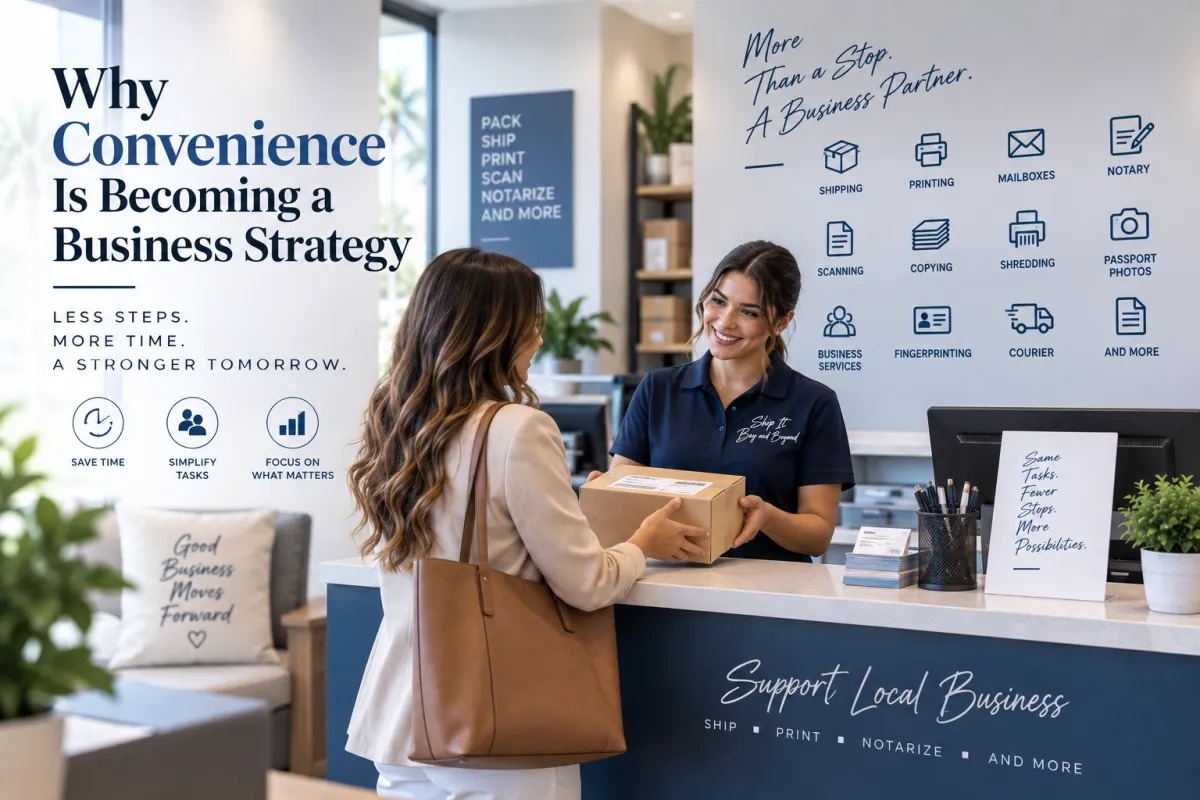
Why Convenience Is Becoming a Business Strategy for Small Businesses
Why Convenience Is Becoming a Business Strategy
For a long time, businesses competed on familiar things:
Price. Quality. Location. Selection.
Those things still matter.
But there's another factor becoming increasingly important in how customers choose where to spend their time and money:
Convenience.
People are busy. Business owners are busy. Customers have more options, and they can often switch providers with just a few clicks.
That means making an experience easier can become more than a customer-service feature.
It can become part of the business strategy.
Convenience isn't simply about making customers happy. When designed properly, it can reduce friction, save time, simplify operations, and make a business easier to work with.
What Does Convenience Mean in Business?
Convenience isn't just about being located nearby.
It can mean different things depending on the business.
For a customer, convenience might mean:
Easy scheduling
Simple instructions
Multiple services in one place
Flexible options
Easy communication
Fast transactions
Convenient payment methods
For a business owner, convenience might mean:
Fewer errands
Simplified workflows
Reliable service providers
Easy access to equipment
Less administrative work
Fewer vendors to coordinate
At its core, convenience is about reducing unnecessary effort.
Why Does Convenience Matter So Much?
Every customer interaction requires some level of effort.
They may have to:
Find a provider.
Research their options.
Travel to the location.
Wait for service.
Complete paperwork.
Make a payment.
Follow up afterward.
Businesses can't eliminate every step.
But they can ask:
Which steps are necessary, and which ones are simply friction?
Reducing unnecessary friction can make an experience easier without compromising quality.
Convenience Is Really About Saving Time
One of the biggest benefits of convenience is simple:
It gives people time back.
Consider a business owner who needs to print documents, scan paperwork, ship a package, and handle business mail.
If those tasks require several different locations, the actual cost isn't just the price of each service.
There's also:
Driving time
Waiting time
Planning time
Coordination
Fuel and transportation costs
Interruptions to the workday
Combining several related tasks into one stop can reduce some of that overhead.
For a busy entrepreneur, those saved minutes can add up.
The Hidden Cost of Friction
Businesses often calculate obvious costs.
They know how much they spend on supplies, software, rent, or advertising.
But friction has a cost, too.
For example, imagine a process that takes an extra 10 minutes every time it is completed.
If employees perform that process 10 times per week, that's approximately:
100 minutes per week.
Over a year, that's more than 86 hours spent on that additional step.
The exact impact depends on the business, but the example illustrates an important principle:
Small inefficiencies can become significant when repeated.
Convenience Can Improve the Customer Experience
Customer experience isn't only about friendliness or service quality.
It also includes how easy it is to accomplish the customer's goal.
Think about the difference between:
"Here are five places you need to go."
and
"We can help you handle several of those needs here."
The second experience reduces the customer's workload.
That can influence how customers perceive the business—even when the individual services themselves haven't changed.
One-Stop Services Are an Example of Convenience Strategy
A one-stop business model is built around a simple idea:
Make related services available in one location.
For example, a customer might need:
Printing
Copying
Scanning
Packing
Shipping
Mailbox services
Notary services
When complementary services are available together, customers can potentially accomplish multiple tasks during one visit.
This doesn't mean every business needs to become a one-stop shop.
It means businesses should look at their customers' needs and identify where combining related solutions could remove unnecessary steps.
Convenience Can Help Small Businesses Use Their Resources Better
Large companies may have dedicated departments for different responsibilities.
Small businesses often have much smaller teams.
An owner may simultaneously manage:
Sales
Marketing
Operations
Customer service
Administration
Shipping
Finance
When resources are limited, efficiency becomes particularly important.
A business doesn't necessarily need to eliminate every task.
Instead, it can decide:
Which tasks require our team's attention, and which can be handled more efficiently elsewhere?
Convenience Doesn't Mean Cutting Corners
This is an important distinction.
Good convenience removes unnecessary effort.
Bad convenience removes necessary safeguards.
For example, a business shouldn't sacrifice:
Security
Accuracy
Quality
Privacy
Proper documentation
Customer communication
just to make something faster.
The goal should be:
Simple + Reliable + Professional
—not simply fast.
Technology Is Making Convenience Easier
Technology has dramatically changed customer expectations.
People can now:
Book appointments online
Track packages
Order products from their phones
Pay electronically
Access documents remotely
Receive notifications
Communicate instantly
These experiences have made convenience an expected part of many transactions.
But technology isn't the only way to create convenience.
Sometimes the best solution is simply having the right physical services available when people need them.
Physical Convenience Still Matters in a Digital World
A business can be completely digital and still have physical needs.
An online seller still needs to ship products.
A remote professional may still need printed documents.
A home-based business may need a professional mailing address.
A company may need documents scanned or securely shredded.
An entrepreneur may need something notarized.
This creates an interesting opportunity for local businesses:
Use technology where it helps, and provide human, physical support where technology can't replace it.
Convenience Can Become Part of Your Brand
Brands aren't built only through logos and colors.
They are also built through experiences.
If customers repeatedly experience your business as:
Easy to work with
Responsive
Organized
Accessible
Reliable
those experiences can become associated with your brand.
Eventually, customers may not simply think:
"They provide this service."
They may think:
"They're the place I go when I need to get this done."
That kind of familiarity can be valuable.
How Businesses Can Build a Convenience Strategy
You don't need to redesign your entire business overnight.
Start with the customer journey.
Step 1: Identify Common Customer Tasks
What are customers actually trying to accomplish?
Look beyond the individual product or service.
Step 2: Identify Friction
Where do customers experience:
Waiting?
Confusion?
Extra trips?
Repetitive paperwork?
Difficult communication?
Too many steps?
Step 3: Look for Opportunities to Combine
Can related services be bundled, coordinated, or completed together?
Step 4: Use Technology Where It Helps
Automate repetitive processes when appropriate.
Step 5: Keep the Human Element
Some customers still want to talk to a knowledgeable person, especially when something is complicated or important.
Step 6: Measure the Results
Look at:
Customer feedback
Repeat business
Processing time
Errors
Employee workload
Number of steps in a process
Convenience becomes more useful when it's designed intentionally rather than added randomly.
Convenience Can Benefit Employees, Too
Business strategy isn't only about customers.
Employees experience friction as well.
A complicated internal process can result in:
Lost time
Repeated work
Mistakes
Frustration
Slower customer service
Making internal operations easier can help employees spend more time on meaningful work.
In other words:
A convenient business can be easier for both customers and employees to navigate.
Why Convenience May Matter Even More for Small Businesses
Small businesses don't always have the resources to compete with larger companies on price, advertising, or scale.
But they can focus on how they serve their customers.
That might mean:
Being easier to reach
Providing multiple related services
Offering personalized assistance
Reducing unnecessary steps
Building local relationships
Creating a smoother experience
Convenience isn't a substitute for quality.
But when quality and convenience work together, businesses can create a more complete customer experience.
How Ship It - Bay & Beyond Can Help
At Ship It - Bay & Beyond, convenience is built into the way we serve businesses, entrepreneurs, and individuals.
Instead of visiting several locations for everyday needs, customers can access multiple services in one place, including:
Professional packing and shipping
Private mailboxes
Virtual mailbox services
Package receiving
Printing
Copying
Document scanning
Secure document shredding
Notary services
Fingerprinting
Passport photos
Business formation support
Office services
For a busy business owner, having access to multiple complementary services can help reduce unnecessary trips and make everyday tasks easier to manage.
One location. Multiple solutions. Less running around.
Proudly Serving the Tampa Bay Area
Ship It! Bay & Beyond proudly serves:
St. Petersburg
Tampa
Clearwater
Largo
Pinellas Park
Seminole
Gulfport
Kenneth City
Treasure Island
St. Pete Beach
Madeira Beach
Indian Rocks Beach
Indian Shores
Redington Beach
North Redington Beach
Redington Shores
Safety Harbor
Oldsmar
Dunedin
Palm Harbor
Tarpon Springs
Belleair
Belleair Bluffs
Lealman
Pinellas County
Hillsborough County
Surrounding communities
Whether you need professional packing & shipping, printing, a private or virtual mailbox, notary, fingerprinting, secure shredding, document scanning, copying, passport photos, business formation, or office services, Ship It - Bay & Beyond is your trusted local partner.
The Bottom Line
Convenience is no longer simply a nice extra.
For many businesses, it can become a deliberate part of how they operate and serve customers.
The strategy is straightforward:
Identify friction.
Remove unnecessary steps.
Combine related solutions.
Use technology intelligently.
Protect quality and security.
Give people more control over their time.
A business doesn't have to offer everything to be convenient.
Sometimes, it simply needs to make the things its customers already need easier to accomplish.
