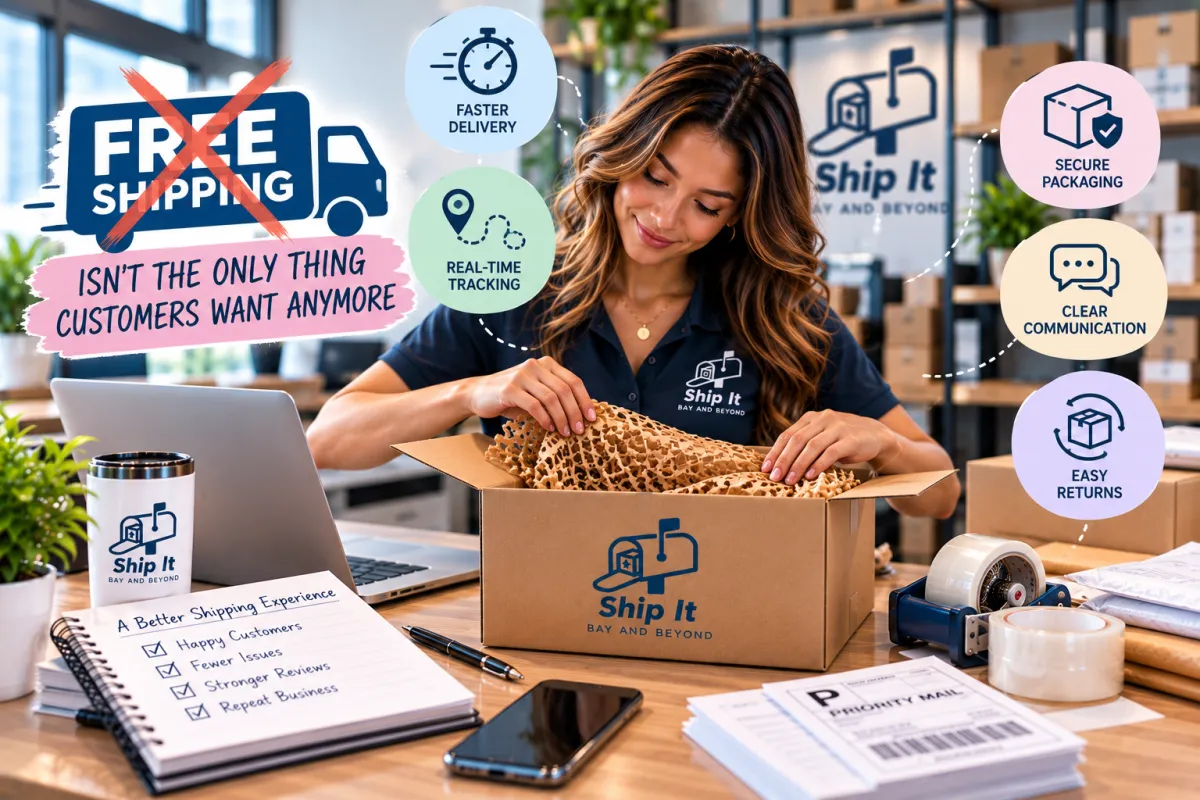
Why “Free Shipping” Isn't the Only Thing Customers Want Anymore
Why “Free Shipping” Isn't the Only Thing Customers Want Anymore
For years, “Free Shipping” has been one of the most powerful phrases in ecommerce.
It catches attention.
It can reduce hesitation.
It can make an offer feel more attractive.
But here's the thing:
Free shipping doesn't automatically create a great customer experience.
Customers also care about when their order will arrive, whether they can track it, whether the package arrives safely, how easy returns are, and whether the business communicates clearly.
A package that costs nothing to ship but arrives late, damaged, or without useful tracking can still create frustration.
Today's shipping experience is about much more than price.
Customers aren't only asking, “Is shipping free?” They're asking, “Will this entire experience be easy?”
Why Free Shipping Became So Important
Shipping fees can feel like an unexpected cost.
A customer may find a product at an attractive price, add it to their cart, and then see an additional shipping charge at checkout.
That can change how they perceive the total purchase.
Free shipping can simplify the buying decision by making the final cost easier to understand.
But businesses still have to account for the actual cost of shipping.
Free shipping isn't truly free to the business.
Someone still pays for:
Packaging
Labor
Carrier services
Shipping materials
Handling
Returns
Damaged shipments
That's why businesses need to consider the total economics of their shipping strategy, not simply whether they can advertise "free shipping."
Customers Also Want Predictability
Imagine choosing between two shipping options.
Option A
Free shipping, but the delivery date is unclear.
Option B
A clearly stated delivery window with reliable tracking.
Many customers may value knowing when their package is expected to arrive rather than simply seeing a zero-dollar shipping charge.
Predictability helps customers plan.
This can matter even more when the purchase is:
A gift
Needed for an event
Time-sensitive
A replacement item
Part of a business operation
Speed Matters—but It Isn't Everything
Fast shipping can be valuable.
But businesses shouldn't assume that every customer needs the fastest possible option.
Different customers have different priorities.
Someone ordering a replacement item may want it quickly.
Someone buying a non-urgent product may prefer a lower-cost option.
The important thing is to provide clear expectations and appropriate choices where practical.
Instead of simply promising "fast shipping," businesses can communicate:
Processing time
Estimated delivery window
Available shipping options
Tracking availability
Clarity can be just as important as speed.
Tracking Reduces Uncertainty
Once an order leaves the business, customers naturally want to know where it is.
Tracking can answer questions such as:
Has my order shipped?
Where is it now?
When should I expect it?
Has it been delivered?
Without useful tracking information, customers may contact the business simply because they don't know what's happening.
A tracking number doesn't guarantee a perfect delivery experience.
But it can give customers visibility into the journey.
Communication Matters When Something Goes Wrong
Even well-organized businesses can encounter shipping problems.
Packages can be delayed.
Addresses can be entered incorrectly.
Weather can disrupt transportation.
Carrier operations can change.
Packages can sometimes be damaged or misplaced.
Businesses can't control every part of the shipping network.
They can control how they communicate.
If something goes wrong, customers generally benefit from knowing:
What happened
What information is available
What happens next
Who they should contact
What the business is doing to help
Silence can create more frustration than the original problem.
Customers Care About What's Inside the Box
The shipping experience doesn't end at the front door.
The customer eventually opens the package.
That's when they see:
The condition of the box
How the product was protected
How the contents were arranged
Whether anything was damaged
Whether instructions were included
Whether the package feels thoughtfully prepared
Packaging becomes part of the experience.
It doesn't need to be expensive or elaborate.
It needs to be appropriate, secure, and intentional.
Free Shipping Doesn't Protect a Damaged Product
Imagine receiving an order with free shipping.
The customer opens the package.
The product is damaged because it wasn't adequately protected.
The customer probably isn't thinking:
"At least shipping was free."
They're thinking:
"My product arrived damaged."
This is why packaging should be considered a critical part of shipping strategy.
Businesses should choose packaging based on:
Product type
Weight
Fragility
Dimensions
Shipping conditions
Appropriate cushioning
The cheapest packaging solution isn't always the most economical one if it increases the risk of damage.
Customers Want a Simple Returns Process
Shipping doesn't end when the product is delivered.
For many businesses, the customer journey can continue through:
Purchase → Delivery → Use → Return or Exchange → Resolution
If a customer needs to return something, the process should be as clear as possible.
Businesses can help by clearly communicating:
Return policies
Time limits
Eligibility
Return instructions
Refund or exchange procedures
Who pays return shipping when applicable
A confusing return process can overshadow an otherwise positive purchase experience.
Transparency Can Be More Valuable Than a “Free” Promise
Consider two businesses.
Business A
FREE SHIPPING!
But the delivery window isn't clearly explained.
Business B
Shipping calculated at checkout. Orders process within X business days. Tracking provided when available.
The second business may not have the flashiest offer.
But clear expectations help customers understand what they're actually purchasing.
The lesson isn't that free shipping is bad.
It's that free shipping shouldn't be the only message.
Customers Are Buying Convenience
Shipping is ultimately about convenience.
Customers are paying a business to make something easier.
That convenience can involve:
Ordering online
Receiving the product at home
Tracking the shipment
Knowing when it will arrive
Opening a properly packed package
Getting help when something goes wrong
The shipping charge is only one part of that experience.
A strong shipping process reduces friction from beginning to end.
Small Businesses Can Compete on Experience
A small business may not always be able to match the shipping infrastructure of a major retailer.
That's okay.
There are other ways to create a professional shipping experience.
For example:
Set Clear Expectations
Tell customers when orders are processed and provide realistic delivery windows.
Pack Carefully
Use appropriate materials and secure the contents.
Communicate
Provide shipping updates and respond when customers have questions.
Make Tracking Easy
Give customers access to available tracking information.
Make Returns Understandable
Provide clear instructions instead of making customers search for answers.
Add a Personal Touch
A simple thank-you message or thoughtful insert can make the experience feel more personal.
The Cheapest Shipping Option Isn't Always the Best Option
Businesses naturally want to control expenses.
But shipping decisions should consider more than the initial price.
Think about:
Delivery time
Reliability
Tracking
Package size
Product value
Damage risk
Customer expectations
Return costs
A cheaper shipping option may make sense for one product and not another.
The right approach depends on the business and the shipment.
Right-Sized Packaging Can Help
Shipping costs can be influenced by both weight and package dimensions, depending on the carrier and service.
That makes packaging decisions important.
A package that is much larger than the product may require:
More material
More protective filler
More storage space
Greater shipping volume
Right-sizing doesn't mean using the smallest possible box.
It means selecting packaging that provides adequate protection without unnecessary space.
Shipping Is Part of Your Brand
Customers don't always separate shipping from the rest of the business.
If the website looks professional but the package arrives poorly prepared, the overall impression can suffer.
If the product is excellent but communication is confusing, the customer may still feel frustrated.
If the package arrives safely, on time, and as expected, shipping can reinforce the positive experience.
That's why shipping should be treated as part of the customer journey—not simply an operational task.
A Better Shipping Strategy Starts With the Customer
Instead of asking only:
"How can we offer free shipping?"
Consider asking:
What does our customer actually need?
Maybe it's speed.
Maybe it's predictability.
Maybe it's tracking.
Maybe it's careful packaging.
Maybe it's easy returns.
Maybe it's simply knowing that someone will respond if there's a problem.
Different customers may value different things.
The goal is to understand those needs and build a shipping process around them.
A Simple Shipping Experience Checklist
Before sending an order, ask:
✓ Is the product properly protected?
✓ Is the package appropriately sized?
✓ Is the shipping address accurate?
✓ Is the shipping option appropriate?
✓ Is tracking available?
✓ Are delivery expectations clear?
✓ Does the package represent the brand professionally?
✓ Does the customer know what to do if something goes wrong?
✓ Is the return process easy to understand?
These questions can reveal opportunities to improve the customer experience beyond simply offering free shipping.
How Ship It - Bay & Beyond Can Help
At Ship It - Bay & Beyond, we help businesses and individuals with the physical side of the shipping experience.
Our services include:
Professional packing
Packing materials
Shipping
Package receiving
Private mailboxes
Virtual mailbox services
Printing
Copying
Document scanning
Secure document shredding
Notary services
Fingerprinting
Passport photos
Business formation support
Office services
Whether you're shipping a product to a customer, sending important documents, or preparing a fragile package, professional packing and shipping can help make the process easier.
Because a successful shipment isn't just about what it costs.
It's about how smoothly the entire experience works.
Proudly Serving the Tampa Bay Area
Ship It - Bay & Beyond proudly serves:
St. Petersburg
Tampa
Clearwater
Largo
Pinellas Park
Seminole
Gulfport
Kenneth City
Treasure Island
St. Pete Beach
Madeira Beach
Indian Rocks Beach
Indian Shores
Redington Beach
North Redington Beach
Redington Shores
Safety Harbor
Oldsmar
Dunedin
Palm Harbor
Tarpon Springs
Belleair
Belleair Bluffs
Lealman
Pinellas County
Hillsborough County
Surrounding communities
Whether you need professional packing & shipping, printing, a private or virtual mailbox, notary, fingerprinting, secure shredding, document scanning, copying, passport photos, business formation, or office services, Ship It - Bay & Beyond is your trusted local partner.
The Bottom Line
Free shipping can be a powerful offer.
But it isn't the entire customer experience.
Customers may also care about:
Predictable delivery.
Clear communication.
Reliable tracking.
Secure packaging.
Easy returns.
Accurate expectations.
Professional service.
A shipping strategy should balance cost with what customers actually experience.
Because a package isn't successful simply because it was shipped for free.
