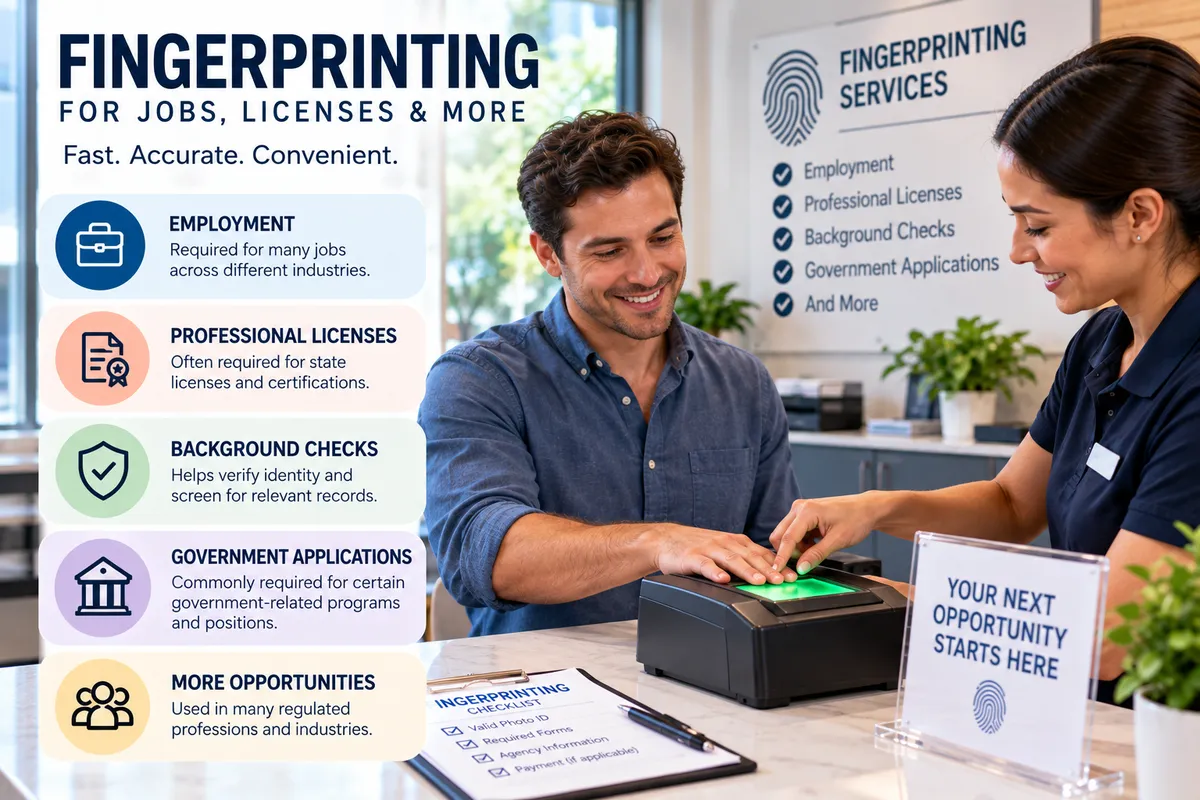
Why Jobs and Professional Licenses Require Fingerprinting
Why More Jobs and Licensing Processes Require Fingerprinting
Introduction: Got the Job Opportunity? Don't Forget This Important Step.
You've submitted your application, completed the interview, and received exciting news: you're moving forward in the hiring process!
Then comes the paperwork. Your employer asks for identification, background screening, and possibly fingerprinting before you can officially start.
The same situation can happen when you're applying for a professional license, renewing a credential, or pursuing a role that requires additional screening.
Why are fingerprints needed? Isn't providing your name and identification enough?
In certain employment and licensing processes, fingerprinting provides another way to verify identity and conduct a fingerprint-based background check. It can help the responsible organization make more informed decisions when screening is required by law, regulation, or its applicable procedures.
As background-check requirements vary across industries and agencies, understanding the process can help you prepare for your next career opportunity.
Let's look at why fingerprinting is required in some situations, who may need it, and what you should know before scheduling an appointment.
1. Why Are Fingerprint Background Checks Used?
A fingerprint background check uses fingerprint information to help identify records associated with an individual.
Unlike a name-based search, which relies on identifying details such as a person's name and date of birth, a fingerprint-based check uses fingerprint comparisons as part of the identification process.
This can be important when an employer or licensing authority needs to follow specific screening requirements.
Fingerprinting may help organizations:
Verify an applicant's identity as part of an authorized screening process
Check for potentially relevant criminal history records
Meet applicable legal or regulatory requirements
Support consistent screening procedures for certain positions or licenses
However, fingerprinting does not automatically reveal every aspect of a person's history, guarantee that every record will be found, or determine whether an applicant is approved.
The receiving agency evaluates the information according to the rules and requirements that apply to the application.
The key takeaway: Fingerprinting is a tool used in certain identity-verification and background-check processes—not a universal requirement for every job or professional license.
2. Which Jobs May Require Fingerprinting?
Whether you need fingerprinting depends on your job duties, employer, jurisdiction, and the laws or regulations governing the position.
Certain roles may require fingerprint-based screening because they involve regulated responsibilities, access to sensitive environments, or specific legal requirements.
Examples can include:
Healthcare and caregiving
Certain healthcare workers, caregivers, and applicants for regulated healthcare positions may need fingerprint-based background checks before employment, licensing, or placement.
Requirements differ by role and jurisdiction.
Education and childcare
Some teachers, childcare workers, school employees, and individuals working with children must complete fingerprint-based screening under applicable laws or employer requirements.
Government and government-related positions
Certain government jobs and eligible contractor positions require fingerprinting as part of employment screening, security procedures, or other authorization processes.
Security-related occupations
Some security positions and other regulated roles require fingerprint-based background checks before an individual can obtain the necessary license or authorization.
Other regulated professions
Depending on the applicable rules, fingerprinting may also be required for certain financial, professional, and public-service positions.
If you're applying for a job, don't assume fingerprinting is required simply because the role falls into one of these categories. Check the instructions provided by your employer or licensing authority.
3. Why Do Professional Licensing Agencies Require Fingerprinting?
A professional license often allows someone to perform work that is subject to specific legal, ethical, or regulatory standards.
Depending on the profession, licensing authorities may require background screening before issuing or renewing a license.
Fingerprinting can be part of this process when the relevant laws or licensing rules call for it.
For example, certain applicants for healthcare credentials, education-related credentials, security licenses, or other regulated professional authorizations may need to complete fingerprint-based screening.
The purpose is not simply to add another form to your application. It's to help the responsible agency evaluate the application using the screening process required for that profession.
Before scheduling, review your licensing instructions carefully. The agency may specify:
The type of fingerprinting required
The approved service provider or submission method
An agency identifier or other routing information
Required identification and forms
Application deadlines and processing expectations
Completing fingerprinting correctly is an important step, but it does not guarantee that your license will be approved.
4. Electronic Fingerprinting Has Made the Process More Convenient
Technology has changed how fingerprints can be captured and submitted.
Traditional fingerprinting may involve recording prints on a physical card using ink. Electronic fingerprinting uses a digital scanner to capture fingerprint images.
You may hear electronic fingerprinting referred to as Live Scan, although the exact services offered and the submission process depend on the provider and program.
Electronic fingerprinting can offer several practical advantages when it is accepted by the requesting agency:
Digital capture: Fingerprints are recorded using a specialized scanner.
Image-quality checks: The technician may be able to identify unclear prints and attempt another capture.
Electronic submission: Some programs allow fingerprints to be transmitted through an approved electronic system.
Less paperwork in some processes: Electronic submission may eliminate the need to mail a physical fingerprint card.
Not every program accepts every electronic fingerprinting service. Some require a specific vendor, agency identifier, or submission channel.
Before booking, confirm that the provider can accommodate the exact fingerprinting process requested by your employer or licensing agency.
5. What Happens During a Fingerprinting Appointment?
If you've never had your fingerprints taken, the process may sound more complicated than it actually is.
Step 1: Check your instructions
Step 2: Bring the required identification
Step 3: Have your fingerprints captured
Step 4: Confirm the next steps
The appointment itself may be relatively quick, but the background-check process can take longer. Processing times depend on the receiving agency, the type of screening, and whether additional review is needed.
6. What Should You Bring to Your Fingerprinting Appointment?
Being prepared can help prevent unnecessary delays.
Before leaving home, review your employer's or licensing agency's instructions and confirm which items are required.
Your checklist may include:
Accepted photo identification: Bring the specific government-issued ID required by the program.
Appointment confirmation: Have your booking details available if applicable.
Agency instructions: Bring any required forms, authorization information, or service codes.
Agency identifier: Some programs require an ORI number or another identifier to route the submission correctly.
Payment: Confirm the service fee and accepted payment methods in advance.
Requirements vary, so don't assume that every fingerprinting appointment follows the same procedure.
If you're unsure what to bring, contact the fingerprinting provider before your visit.
7. Can Fingerprinting Delay Your Job or License Application?
It can, particularly if the wrong service is selected, required information is missing, or the receiving agency needs additional time to process the submission.
Here are common issues to watch for:
Booking the wrong type of fingerprinting. A provider may offer fingerprint capture but not support the specific screening program you need.
Providing incorrect agency information. Missing or inaccurate routing details may lead to delays or a rejected submission.
Waiting until the last minute. The appointment and the background-check review are separate stages, and processing times vary.
Assuming the appointment means approval. Fingerprint capture does not mean the background check is complete or that your application has been approved.
Not keeping confirmation details. A receipt or reference number may be useful if you need to follow up with the provider or requesting agency.
The best approach is to start early, follow the instructions carefully, and confirm the next steps before leaving your appointment.
8. Does Everyone Need Fingerprinting for Employment?
No. Fingerprinting is not a universal requirement for all jobs or professional licenses.
Some employers use other forms of identity verification or background screening. Others are required to use fingerprint-based checks because of laws, regulations, licensing rules, or the nature of the position.
The same is true of professional licenses: requirements vary depending on the occupation and the responsible licensing authority.
If you aren't sure whether fingerprinting is required, ask your employer, recruiter, or licensing agency.
Confirming the requirement before scheduling can save you time, money, and the frustration of completing the wrong screening process.
How Ship It! Bay & Beyond Can Help
Starting a new job or applying for a professional license is exciting, but navigating the paperwork can feel overwhelming.
At Ship It - Bay & Beyond, we offer fingerprinting services alongside other convenient business and document services at our St. Petersburg location.
If you need fingerprinting for employment, licensing, or another screening requirement, contact our team before visiting to confirm availability, accepted identification, appointment requirements, and whether we can accommodate the specific program requested by your employer or licensing agency.
Our additional services include:
Packing and shipping: Send packages and important documents through available carrier options.
Private mailboxes and package receiving: Manage eligible business correspondence and deliveries.
Printing, copying, and scanning: Prepare paperwork and business materials.
Notary services: Get assistance with eligible notarization needs.
Passport photos: Ask about photos for qualifying applications.
Document shredding: Arrange secure disposal of eligible documents.
Business services: Explore business formation-related and other administrative services.
U-Haul and moving supplies: Find practical support for eligible moving and transportation needs.
Visit Ship It - Bay & Beyond
5420 Central Ave
St. Petersburg, FL 33707
Phone: 727-344-9052
Email:[email protected]
Business hours: Monday–Friday, 9 AM–6 PM; Saturday, 9 AM–3 PM; Sunday closed.
Call ahead to verify that our available fingerprinting services match your specific requirements.
Proudly Serving the Tampa Bay Area
Ship It - Bay & Beyond is proud to support job applicants, professionals, entrepreneurs, and small businesses throughout:
St. Petersburg
Tampa
Clearwater
Largo
Pinellas Park
Seminole
Gulfport
Kenneth City
Treasure Island
St. Pete Beach
Madeira Beach
Indian Rocks Beach
Indian Shores
Redington Beach
North Redington Beach
Redington Shores
Safety Harbor
Oldsmar
Dunedin
Palm Harbor
Tarpon Springs
Belleair
Belleair Bluffs
Lealman
Pinellas County
Hillsborough County
Surrounding communities
Whether you need fingerprinting, notary services, printing, document scanning, secure shredding, copying, passport photos, private mailbox services, package receiving, packing and shipping, or other office services, Ship It! Bay & Beyond is your local partner for everyday needs.
The Bottom Line
Fingerprinting has an important role in certain employment and professional licensing processes because it helps support identity verification and fingerprint-based background checks.
For applicants, understanding the requirements before scheduling can make the process much easier. Confirm the correct service, bring the required information, allow time for processing, and follow up with the organization handling your application if needed.
You don't have to figure everything out at the last minute. A little preparation can help you take this important step toward your next career opportunity with greater confidence.
Let's talk! Have you ever needed fingerprinting for a new job, professional license, or background check? What was the most confusing part of the process? Share your experience in the comments!
