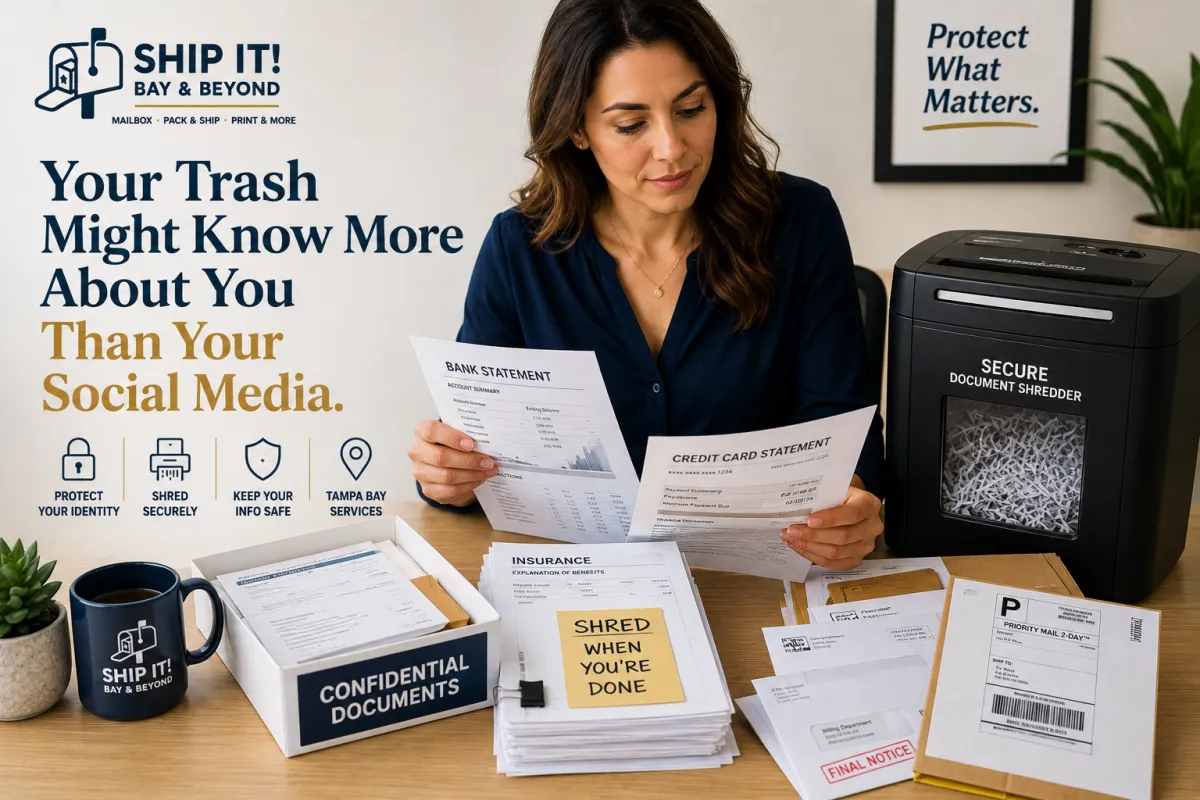
Your Trash Might Know More About You Than Your Social Media | Secure Document Shredding
Your Trash Might Know More About You Than Your Social Media
You probably think about protecting your personal information online.
You use strong passwords.
You avoid suspicious links.
You protect your accounts.
You think twice before sharing personal details on social media.
But there's another place your information can end up:
Your trash can.
Old bank statements.
Expired IDs.
Medical paperwork.
Credit card offers.
Shipping labels.
Business documents.
You may consider them useless once you're finished with them.
But to someone looking for personal or confidential information, they could tell a surprisingly detailed story.
That's why secure document shredding should be part of your privacy and information-security routine.
Your Trash Can Tell a Story
Think about what someone could potentially learn from discarded paperwork.
A few documents might reveal:
Your full name
Address
Account information
Financial institution
Business relationships
Purchase history
Customer information
Contact information
Transaction details
One document may not seem significant.
But several pieces of information together can create a much clearer picture.
That's the problem with simply throwing sensitive paperwork away.
1. Old Financial Documents
Financial statements can contain information you don't want exposed.
Examples include:
Bank statements
Credit card statements
Investment correspondence
Loan documents
Payment records
Financial offers
When these documents are no longer needed, consider whether they should be securely destroyed rather than placed intact in the trash.
2. Medical and Insurance Documents
Healthcare and insurance paperwork can contain sensitive personal information.
Old documents may include:
Names
Addresses
Policy information
Account numbers
Medical-related information
Insurance details
Before disposing of these records, determine whether you need to retain them for your own records.
If you don't, secure destruction may be a better option than tossing them intact.
3. Tax and Business Documents
Businesses have another layer of responsibility.
Company paperwork may contain:
Customer information
Vendor information
Financial records
Employee information
Account details
Contracts
Internal correspondence
A business shouldn't treat confidential paperwork like ordinary garbage.
Creating a document-retention and secure-destruction process can help reduce unnecessary exposure.
4. Shipping Labels Can Reveal Information Too
This one is easy to overlook.
You receive a package, open it, and throw the box away.
But what about the shipping label?
It may contain:
Your name
Address
Business name
Tracking information
Other shipment details
Before disposing of boxes, consider removing or obscuring labels containing personal or sensitive information.
5. Business Mail Needs Extra Attention
For entrepreneurs and small businesses, discarded paperwork can create an even bigger privacy concern.
Think about how much information passes through a business every week:
Invoices.
Customer forms.
Contracts.
Receipts.
Applications.
Shipping documents.
Internal notes.
Not every document needs to be kept forever.
But documents that are no longer needed should be disposed of appropriately.
6. Don't Shred Everything Without Thinking
Secure shredding is important—but so is knowing what you need to retain.
Some financial, tax, legal, employment, or business records may need to be kept for a specific period.
Before destroying important documents:
Determine whether you still need them.
When you're unsure about legal or tax record-retention requirements, consult an appropriately qualified professional.
Once you've confirmed that a document no longer needs to be retained, secure destruction can help protect the information it contains.
7. Home Offices Need a Shredding Routine Too
Working from home doesn't mean information security stops at your front door.
If you run a business from home, you may have confidential paperwork mixed in with everyday household documents.
Create a simple routine:
Keep
Documents you still need.
Organize
Records that need to be retained.
Shred
Confidential documents that are no longer necessary.
Recycle
Paper that contains no sensitive information and can be appropriately recycled.
A simple system can prevent sensitive paperwork from piling up.
8. Don't Rely on Your Social Media Privacy Settings Alone
You can carefully manage your online presence and still overlook physical information.
Your social media account might be private.
Your passwords might be strong.
But an old document containing your name, address, or account information sitting in an unsecured trash bin can still create unnecessary exposure.
Digital privacy and physical privacy go hand in hand.
9. Secure Shredding Is More Than Cutting Paper
Professional document shredding is designed to destroy documents so the information is much harder to reconstruct.
For businesses and individuals with significant volumes of sensitive paperwork, professional shredding can be a convenient alternative to handling large quantities of documents yourself.
It can also help make secure document disposal part of a repeatable business or household process.
Who Should Consider Secure Document Shredding?
Secure shredding can be useful for:
Families
Dispose of old personal paperwork responsibly.
Small Businesses
Protect customer, employee, and business information.
Home-Based Businesses
Securely destroy confidential records without allowing them to accumulate.
Professionals
Safely dispose of sensitive client and business documents.
Online Sellers
Protect customer and shipping information.
Organizations
Create a more consistent process for handling confidential paperwork.
How Ship It - Bay & Beyond Can Help
At Ship It - Bay & Beyond, we understand that protecting information doesn't stop when you close your computer.
That's why we offer document shredding services along with other mail, shipping, printing, and business solutions.
Our services include:
Document Shredding
Securely dispose of eligible confidential paper documents you no longer need.
Private Mailboxes
Dedicated mailing solutions for personal or business use, subject to applicable requirements.
Package Receiving
Convenient receiving options for eligible packages.
Packing & Shipping
Professional packing and shipping services for personal and business shipments.
Printing & Copying
Business cards, flyers, brochures, documents, and marketing materials.
Document Scanning
Digitize documents when appropriate and help reduce unnecessary paper clutter.
Notary Services
Convenient notary services for eligible personal and business documents.
Fingerprinting
Fingerprinting services for eligible employment, licensing, and other requirements.
Passport Photos
Professional passport photo services.
Proudly Serving the Tampa Bay Area
Ship It - Bay & Beyond proudly serves individuals, families, entrepreneurs, professionals, and businesses throughout the Tampa Bay area, including:
St. Petersburg
Tampa
Clearwater
Largo
Pinellas Park
Seminole
Gulfport
Kenneth City
Treasure Island
St. Pete Beach
Madeira Beach
Indian Rocks Beach
Indian Shores
Redington Beach
North Redington Beach
Redington Shores
Safety Harbor
Oldsmar
Dunedin
Palm Harbor
Tarpon Springs
Belleair
Belleair Bluffs
Lealman
Pinellas County
Hillsborough County
And surrounding communities.
Whether you need secure document shredding, private or virtual mailbox services, package receiving, professional packing and shipping, printing, copying, document scanning, notary services, fingerprinting, passport photos, or business support, Ship It! Bay & Beyond is your trusted local partner.
The Bottom Line
Your trash may not look valuable.
But the information inside it can be.
Protecting your identity and confidential information means thinking beyond passwords and social media.
It means paying attention to the paperwork you leave behind.
Before tossing that old statement, shipping label, invoice, or business document into the trash, stop and ask:
"Does this contain information I wouldn't want a stranger to have?"
If the answer is yes, don't just throw it away.
Shred it securely.
At Ship It - Bay & Beyond, we're here to help you protect what matters—from the mail you receive to the documents you're ready to let go.
Protect What Matters Question
What's the one type of paperwork you always make sure to shred?
Financial documents
Bills
Receipts
Business records
Shipping labels
I need to start shredding more!
Tell us your answer in the comments!
Frequently Asked Questions
Why should I shred personal documents?
Sensitive paperwork can contain information such as names, addresses, account details, and other personal or confidential information. Secure shredding can reduce the risk of that information being exposed after disposal.
What documents should I consider shredding?
Examples can include old financial statements, credit offers, insurance documents, confidential business paperwork, and other records containing sensitive information once you're certain they no longer need to be retained.
Should businesses shred confidential documents?
Businesses should establish appropriate document-retention and destruction procedures for confidential information. Secure shredding can be an important part of that process.
Can I shred shipping labels?
Yes, if you're disposing of a label containing personal or business information, removing or securely destroying it can help reduce unnecessary exposure.
Should I shred tax documents?
Not necessarily right away. Tax and financial records may need to be retained for a period of time. Confirm applicable record-retention requirements before destroying them.
Is professional document shredding better than shredding at home?
For small amounts of paper, a quality home shredder may be sufficient for some needs. Professional shredding can be particularly convenient for larger volumes of confidential paperwork or businesses that need a repeatable document-destruction process.
